
This website is about using conventional power controls with hand held tethered throttles, provision for one or two operators, flat paper buildings and hidden train staging. The overarching goal of my writings is to show how to have a lot of train operation on a room size layout without spending too much money.

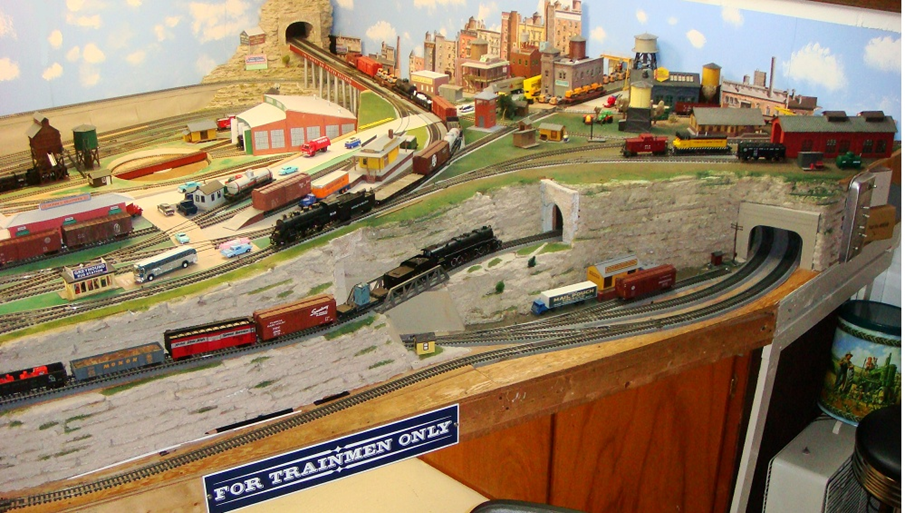
The upper level is Hillton. The interchange track is lowest in foreground.
The Yardley and Hillton Railroad is an HO scale model railroad that allows realistic operation on a single-track twice around oval with three passing sidings with facing and trailing point industries for mainline switching plus a short branch to an industrial town offering interesting switching operations. About one half of the layout is double decked. There also is a freight car classification yard, engine terminal, interchange and staging options. This layout can support all the model railroad movements realistically while keeping two operators busy.
These photos show my layout; built against three basement walls, measuring 11 feet along the back wall and 6 feet along the left wall and 8 feet on the right wall. There is a hole of 2 x 6 feet in the middle for access and operation. Yes, I have to duck under. Along the front of the layout is a fiddle track that is a good place for a visitor to mount his train if he brought one.
This track extends from the mainline toward the left and splits into two hidden storage tracks.
These are hidden interchange tracks representing other off-layout railroads, perhaps Eastbound and Westbound traffic. Town names and freight destinations are shown in bold print.
On the top level is the busy industrial town I call Hillton with lots of rail switching. I often use flat paper buildings for two reasons, one is to save space allowing more railroad operation in a small room, and the other is because they are cheap and easily custom made on the computer.
As for why the name? — I guess because I like descriptive even if unimaginative names. Back about 1981 I built a small experimental, two level switching shelf, based on the Gum Stump & Snowshoe, just 1 foot wide and 71/2 feet long. It had a 2-track yard with a runaround track on the lower level and through a bridge and switchback to an upper level town with 2 industrial spur tracks. Quite naturally I called it the Yardley and Hillton. Soon I got tired of just going back and forth. So after a while I wanted to try more scenery with hills and trees, green grass, tunnels, lakes and buildings, so I built another small portable layout that would fit on a card table. It was just 4-feet square where the trains went round and round on a twice around plan with grade separated crossing and a couple industry spurs. I kept the same name. The experiences gained with those two small layouts strengthened my confidence to build a permanent layout against the room walls. Now this layout – influenced by the Wawbeek & Sunmount RR, by Leonard Blumenschine (published in Nov. 1979 Model Railroader magazine) with enhanced operations and the RR name and herald on some rolling stock follows the idea that ‘bigger is better’.

The layout top level is the industrial town of Hillton located at the end of a short branch with a “Y” track for turning engines around for the return trip. Here there are lots of industries for switching. This town located on almost a raised pedestal is easily accessible from both inside the operating pit and outside from the front. The town has over a dozen industries to take about 18 rail cars and offers lots of switching operation. I use tethered throttles exclusively for train operation because I like to be near the action to assist with coupling if needed and have the controls with me.
If I have a second operator one can work the yard, roundhouse and staging while the other works the mainline or Hillton. Or we can share the operation at Hillton because of the ability to split controls along the big bridge, giving the inner half and a throttle to the man inside the pit and the outer half and branch approach to the other man and throttle.
Building the Y&H took me about 4 or 5 years – then a brake of about 10 years while learning about computers with my vocation, then retirement allowed the time for finishing details and a few changes, and finally this and additional writing to share with others my enjoyment of this fine hobby of Model Railroading which embraces so many aspects.
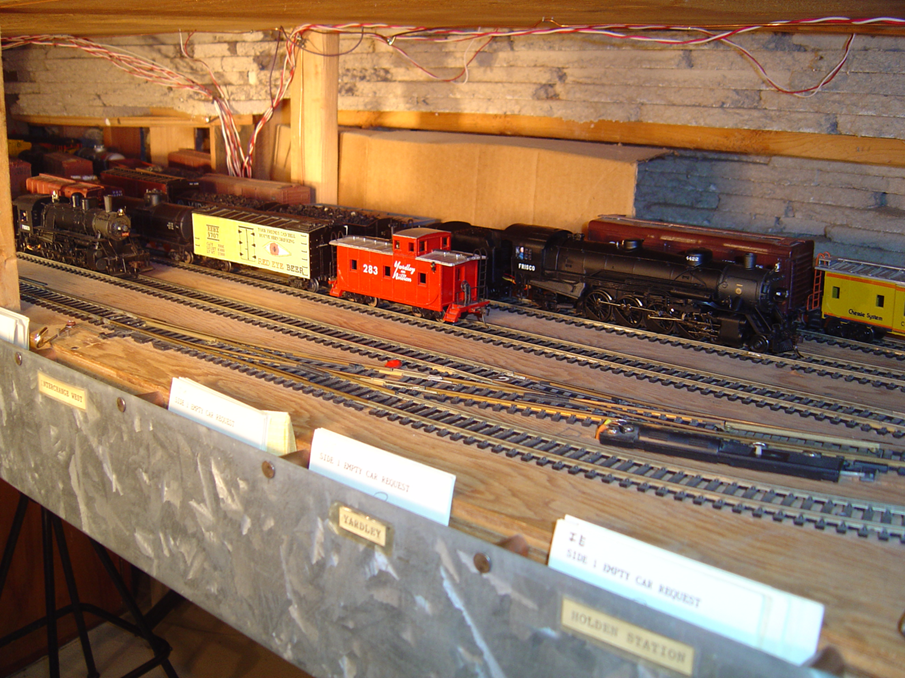
Some freight car forwarding system cards are pocketed in the foreground.
Directly below Hillton and accessed from inside the operating pit is a 4-track, double-ended staging yard that I call Holden. It is handy for temporary storage of trains going in either direction. Operation here is by either mainline A or B throttle or the local Yardley throttle. The track seen here in the lower right corner of the photo is a switcher pocket for resting the Yardley switcher prior to pushing a cut of cars after the road engine heads to the barn. By extending this pocket track another foot or so I was able to include a small freight station for the Holden Freight Agent that usually handles Railway Express less than carload freight.
The Holden bi-directional staging yard (accessed from within the pit) has proven to be quite a valuable aid to operation. Trains there can be powered from either a mainline throttle or the yard throttle. The view above shows some cards used for the freight car forwarding system in storage pockets along the layout edge.
For operating the layout I use home-made tethered transistor throttles powered by old Lionel transformers with the addition of silicon diode bridge rectifiers. I used terminal strips from obsolete electrical equipment. While building this layout I did not want to spend a bunch of money as you can see with the photos.
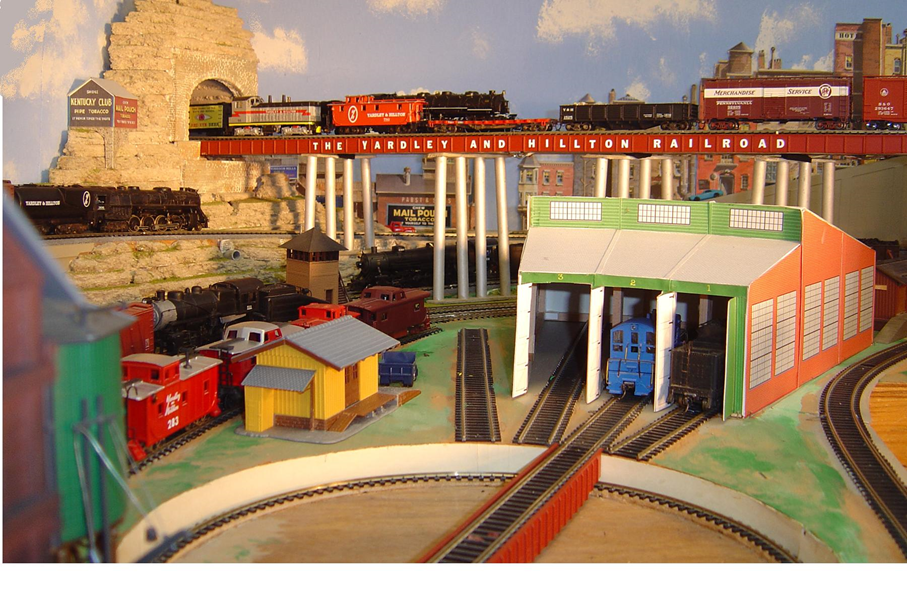
The three stall round house was scratch built and covered with paper sides drawn and printed with the Windows Paint home computer program. These were pasted onto 1/16 inch thick sheet plastic (vinyl) sides attached to a skeleton frame of one-quarter inch square wood sticks. The engine terminal facilities are minimal because there is just not much space. The grass and dirt are simply paint. The caboose track will hold four cabooses, enough for most operations. There is a handy short run-around track for the switcher to get on the other end of a caboose or car for spotting at the few local industries here at Yardley. The track along the right side of the roundhouse serves an industry called the Underhill Fabrication Company.
For operating the layout, there are three separate areas with independent controls. The layout uses an overhead mainline block power selection and turnout control panel (not shown). The Mainline and Interchange tracks can be operated by either of two hand-held throttles A or B. The classification yard and engine facilities are run by the Yardley local throttle or mainline A or B throttles. Only the Yardley throttle can operate the turntable rotation. Its bridge track polarity is automatic. Operation of the industrial town of Hillton can be split along the double track bridge and controlled by either or both its local throttle and or A or B mainline throttle.
For living with the 39-inch high duck-under, I sit in an old office chair with casters, keep my head down, and roll myself under the framework.
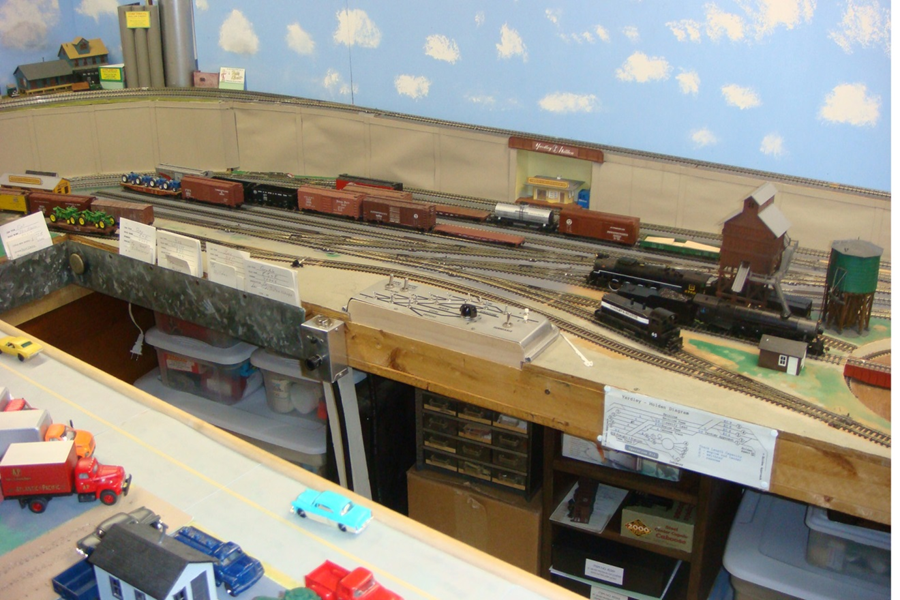
Most of the Yardley classification yard can be seen in the background with its control panel made from an aluminum baking pan for throttle selection and yard turnout controls. Also seen in the distance on the far side of the yard is the Yardley Passenger station under an overhead steel panel bridge. If they can do this in the big cities, I should be able to put mine under the ‘concrete’ walled embankment supporting the mainline track toward the upper level. The yard tethered throttle is hanging on a screw head at the table edge. I like having the throttle with me as I operate the railroad. The railroad uses four of these homemade speed and direction controllers.
Also here for informing a new operator is a printed diagram of the tracks at Yardley and Holden on the edge of the table. The pocketed cards are for the freight car forwarding system. Using a card system can force you to vary your runs and it helps me remember where a given car needs to go when returning to operation after an absence.
In the yard I used Peco turnouts and their electrical remote control motors must be placed in a hole cut into the table under each turnout. This yard with its location inside the loop and the generous train length runaround tracks comprised of the drill lead and engine terminal track allows the yard classification chores to never interfere with mainline running trains. Of course I use KaDee couplers and magnets for uncoupling in strategic places.
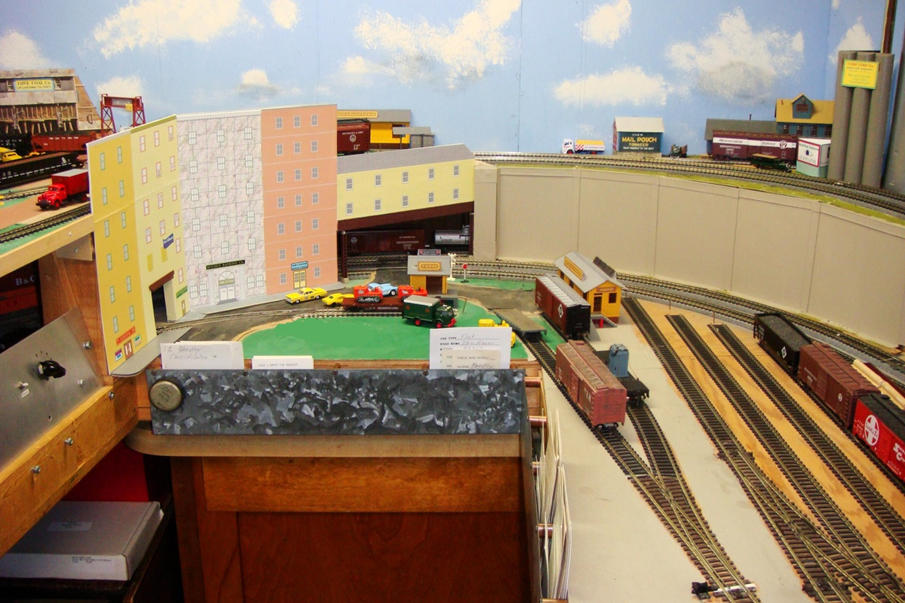
The photo above is taken from inside the operating pit. On the left is the control panel for Holden Staging yard where a single rotary switch controls both turnout routing and track power. In the center of the photo is the tiny Holden Freight station. On the right is Yardley Freight station and classification tracks. The tall building flats here at Holden City shows how I was able to hide the ugly bench work where the layout transitions from one to two levels. These tall storefront buildings are glued to plastic panels held in place with a magnet, and are removable to retrieve a derailment. I discovered later that by making these buildings two stories taller and changing a few tracks on the upper level, they could also serve as building flats for the upper level town of Hillton seen on the next page. This way you get two buildings for space of one.
My usual train length is about 7 or 8 cars. A trip from Interchange could have a dozen. The classification yard and engine facilities approach tracks can handle them. My passing sidings can hold trains of an engine and caboose with about 10 cars. I like steam engines now available with smooth and quiet operation.
This peddler freight style layout and my small work bench fills a spare basement room and can have 3 or 4 trains running without the expense of DCC and signaling. The layout has limited scenery without the mess of plaster, and opportunity for two operators to share the operating fun of forwarding freight cars with a card system and not train load quantities. There is more to learn about the Yardley and Hillton Railroad with additional writing in other books.
 Model Railroading on the Cheap
Leave a comment