This post helps to explain the track schematic and industries diagram of the Hillton industrial complex. The bracketed letters in the text correspond to those circled locations on the schematic diagram shown here. Track car capacities are shown in blue ink.
My hope for the town of Hillton was for it to be a busy little town with lots of industries and complex track work to challenge the local switching crew. I am only slightly disappointed with the outcome, most of which is caused by my space deficiency. This diagram will introduce you to the industries and how I met the challenge of fitting so many features, some of them only flat buildings, into this crowded little town of approximately 20 sq. ft.
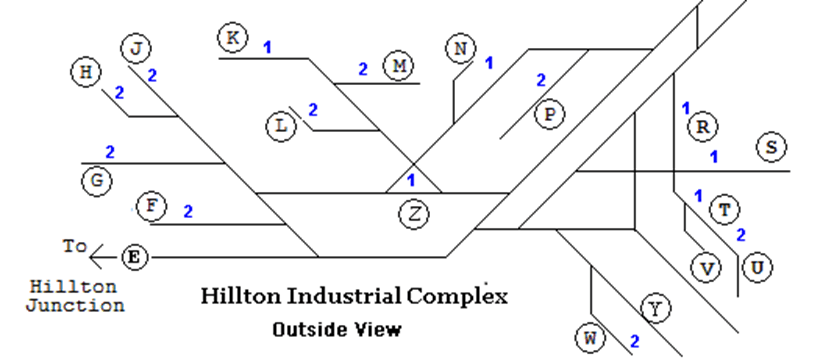
I will start describing the Hillton Industries at the far left as we enter the train room and face the layout. The short branch track (E) comes up a slight grade from the left from the mainline at Hillton Junction. (There is a pictorial view of this on page 69).
Just behind the branch line is a small machine shop (F) that often needs a car or two.
There is a heavy materials yard behind the shop with an overhead crane straddling the track (G). That track can also be shared with the county highway maintenance department for a shipment of large drainage tile etc. This track may also serve as a community team track.
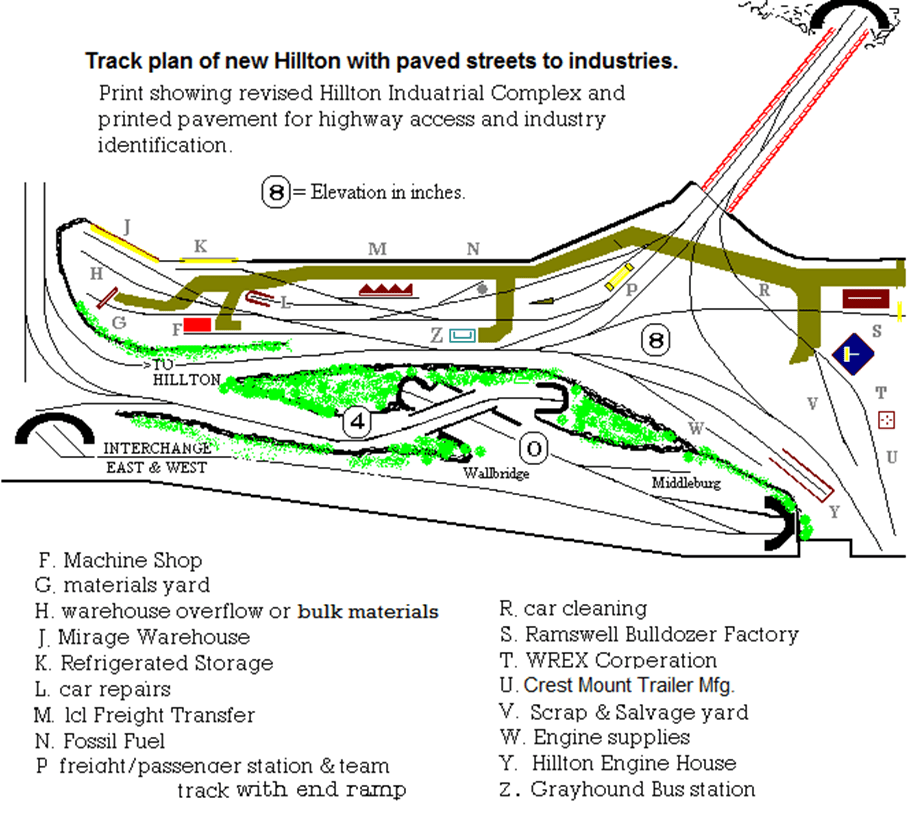
This is the area with which I have struggled for years to make sensible scenery with too much track and not enough space for buildings, roads, shade trees and supporting scenery. Originally I had a large 3-story warehouse building, the Crammedin Warehouse to handle boxcars. It was an open top roofless structure (over a hole (K) in the table edge) to allow light onto the control panel for Holden below (later deemed unnecessary). It was at the inner edge of the upper deck. Recently I felt that if I rearranged the trackage eliminating one industrial spur I could have more room for buildings and the roadways to serve them. After all, even industries served by rail need trucks and automobiles. So I changed the tracks at the left end of Hillton and closed the hole in the table (K) where the warehouse used to be. That allowed me to have a roadway to serve most all of the industrial buildings in town. Now I have a place to use some of today’s beautiful 1950’s era, memory-refreshing cars and trucks that support these scenes.
Still there is not much space on what turned out to be a rather narrow shelf for several industries. I made thin building flats by printing them with the computer. My Mirage Warehouse is the first one that I made on the computer. It is mounted on angle brackets at the table edge. It serves 2 parallel tracks (H & J). This practice was done occasionally in large cities where space was scarce. By spotting 2 box cars (with doors open on both sides) side by side at one warehouse doorway and using removable bridge plates between the cars, 2 cars could be loaded at the same time from one warehouse door. The backside of this warehouse was hidden from view by adding two more stories to two down town Holden City buildings. That was more work with the computer but it is a cheap solution to the problem of no geography. The outer track (H) can alternately serve a bulk material operation (hopper cars & gravel) using an under-the-track conveyor for unloading hopper cars.
Originally, I had hoped that I could have a refrigerated meat distributor and probably an ice house at Hillton for replenishing ice cooled refrigerator cars but the space doesn’t exist. I settled instead for a branch warehouse of the Wilten Produce Company (K), (fruits & vegetables are wiltin’ as soon as you pick them) another building flat so close to the table edge that it is pasted directly on the back of the upper 2 stories of the Holden Five and Dime on the lower level. I like getting 2 buildings for the space of one.
I found a plastic building that holds a car so now I have a rail car repair building (L) or it can serve as the paint shop for WREX. The lead is long enough to hold a second car.
I also made a super thin freight transfer operation (M) between highway trucks and railroad boxcars. These kinds of operation were used for less-than-car load freight prior to the 1960s. I experimented with the computer here to make the entire building including a 4-sided overhanging roof. But it still takes up a good amount of space even though it is only ½ inch thick. It is a facing point industry track that has 3 doors on the rail side, can hold 2 boxcars, and 4 bays for trucks on the highway side. Here I learned that trucks also need a lot of space.
Obviously, desperation scenery has arrived at Hillton.
There is a small time Old Fossil Fuel (coal and oil) Dealer (N) that handles tank or hopper cars (one at a time) on an opposite facing spur track that challenges the switching operation a bit. It is a shame that there is so little room for a pile of coal.
The roadway for trucks turned out to be another challenging job. This highway is another item that I tried using the computer drawing program to make a paved roadway. It is nice to have a sharp yellow line down the middle of the pavement. I even made the familiar white RxR warning in the approach to highway/rail crossings with “Windows Paint” graphics program. I like the results. I used gray pavement color instead of black because even in nature, things soon fade with the weather.
The Y&H uses a combination freight and passenger station (P) here at Hillton. It is located beside the inner passing track. There is also a stub track on the other side of the station for less-than-carload freight shipments and an end ramp for flat cars.
The big bridge is next, 2 tracks wide on a 1 x 4 pine board with a groove for wires cut into the bottom side. It fastens to the layout upper deck with a single screw at one end, along with the wires tied to a screw type terminal strip for easy disconnect. The wires provide power to the 2 tracks and the turnout control coils. This bridgeboard, with the top half of the mountain and tunnel portal attached to the bottom of the board via a piece of tin, is removable. The tunnel is strictly for viewing impact. It goes no-where. There are several aluminum tubes for cosmetic vertical support below this bridge that is covered with the sides from 14 Varney gondola cars lettered with filmless decals by Virnex. A flea market can be a cheap source for ribs and rivets.
Hillton is an industrial complex on a raised plateau for easy access switching at the edge of town with tall buildings we see as flats in the distance. These are Walthers ‘Back Streets’ paper flats cut apart and arranged down the slopping street. The main street of Hillton must be to the other side of these tall buildings. The railroad arrives from the lower right edge of these buildings and appears to continue on through a tunnel at the end of the big steel bridge to the left.
Another major industry is the Ramswell Bulldozer Co (S). Many years ago I found a dozen cheap HO scale plastic caterpillar tractors at a variety store, I bought them all. Now there are several on flat cars around the layout and quite an impressive quantity on the loading dock behind the factory building. That is where I used a trick from John Allen with a mirror on the back of the factory building and a second mirror at the end of track, the edges of which are masked by the yellow overhead crane. The 3 bulldozers in between are visually multiplied by the mirrors. The crane was bashed from an overhead signal bridge and a length of plastic “I” beam stock. After painting it yellow and using a ‘safety first’ decal it looks real good.
First off the near end of the Hillton Big Bridge is a spur track serving 3 industries. One is a spot where a small time operator cares for cleaning and preparing cars for lading. He works with hand tools off the tailgate of his pickup truck. He does not have a permanent building, but instead usually works on a car parked on the approach track (R) to WREX.
The Western Railway Equipment Experimenters (T) is a special fabricating and design company that is instrumental in doing feasibility work on alternative designs of railway equipment for subscriber railroads. Does that sound kit bashing?
Our newest industry is the Crest Mount Manufacturing Co (U). It makes small travel trailers and ships them on flat cars. Another industry with colorful and interesting loads.
We have an expanded scrap steel operation (V) off their own spur track. They now have a larger crawler mounted crane. Their old 25 ton rail born crane, sometimes used for track maintenance, is now stored at the car repair shop.
That seldom used passenger station formerly at (V) that I say had been served by an un-named railroad running through Hillton on what is my tail track and over the big bridge and into the tunnel is now gone. It handled no freight cars from the Y&H. It was a bad idea having a passenger station on a track with stubs in both directions.
Nearby is the Y&H Hillton engine house (Y). I have 2 different engine houses for use here. There is room and track alignment for a 2-stall house. Although I prefer a single stall engine house that allows me to have an open track  beside the engine house. It is good to have a place for a car load of fuel and lubricating oils.
There is a Greyhound Bus Station (Z) that the Y&H occasionally serves for railroad passenger excursion events.
I will probably never have all the space that I would like for buildings, but I realize that one must live within the confines of reality. This is how I crammed as much operation as I could into this major, yet small switching area covering less than 20 square feet on an easily reached pedestal. Here, over a dozen industries can take about eighteen freight cars.
 Model Railroading on the Cheap
Leave a comment