Here are a couple photos of my paper and cardboard wall hiding the supporting frame work for Hillton Junction on the upper level and the view block at Holden City on the lower level. When looking at this picture, also see the photos later in this post for a finished view for reference.
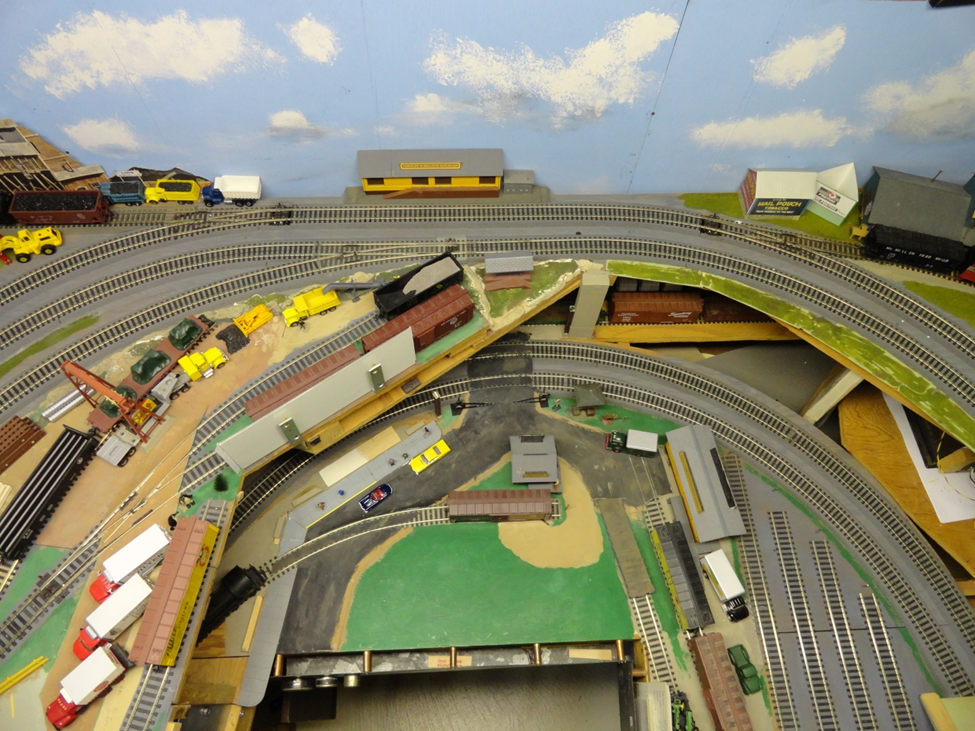
The next photo shows the segmented card work supporting the inside curved heavy paper ‘concrete’ wall. This wall is turned on its face and laid on the yard for the photograph. It shows the short segments of corrugated card board glued atop each other and held while drying overnight by weights for a double layer of foundation. The gray colored heavy card stock walls were glued to this and each other around the outer-back side of this inside curve. There is a thin wood strip (paint stir stick) glued to the back side at the top for strength. Vertical seams in this card wall were masked by a narrow card strips resembling pilasters.


I wanted to get some photos showing as much of the 8 x 11 foot layout built against three walls as possible. So I stood on a step ladder inside the pit and held the camera as high as I could to gather some broad view shots. Here are the results. Remember the layout rests against three walls of the basement train room and the ceiling limits how high one can get with the camera. These pictures were taken before urban renewal took out the seldom used passenger station (seen near the top right corner), and moved the scrap yard to this side of the wood board fence. It is no wonder the passenger station did so little traffic, being located on a track with stubs on both ends. Remember on a small railroad, small structures are big business and take front stage.
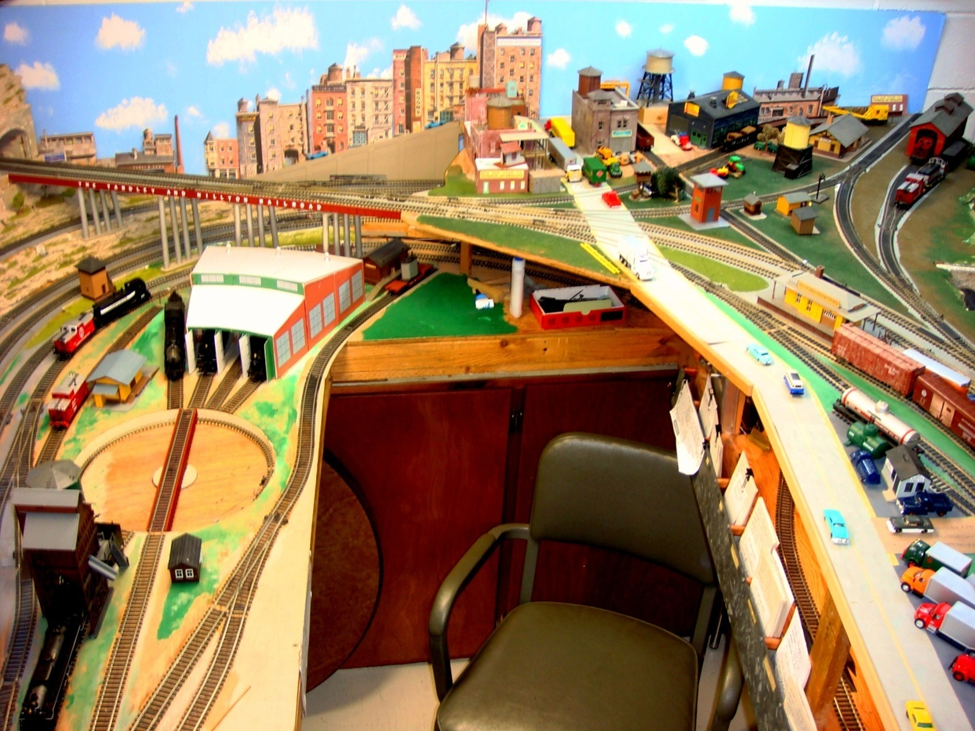
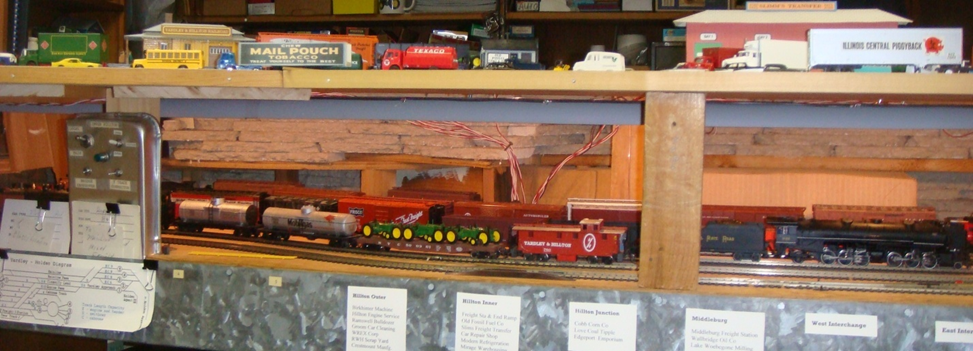
Here I moved the step ladder to inside the operation pit for another high shot. On the left side is the Yardley coal dock, turntable, roundhouse and the Hillton big bridge heading into Wherezatgo Tunnel. In the back is the hand painted blue sky back drop with the Walthers paper building flats, cut apart with scissors, and arranged behind the sloping street. Continuing our tour to the right is a few structures of Hillton, and the now removed passenger station, the ‘Y’ tail track and engine house. Along the right edge is the combination freight-passenger station, some trucks at Slim’s Freight Transfer Operation, the printed paper street for highway vehicles and on the lower level, some cards of the freight car forwarding system in pockets in front of the Holden staging yard. I need the car forwarding system to keep from repeating likeable moves and to remind me of what car is going where when returning to operations after an absence. I want to stress how important the staging yard turned out to be after I got the railroad into operation, it is really quite a valuable addition. There is another view of the hidden staging facility in this post.

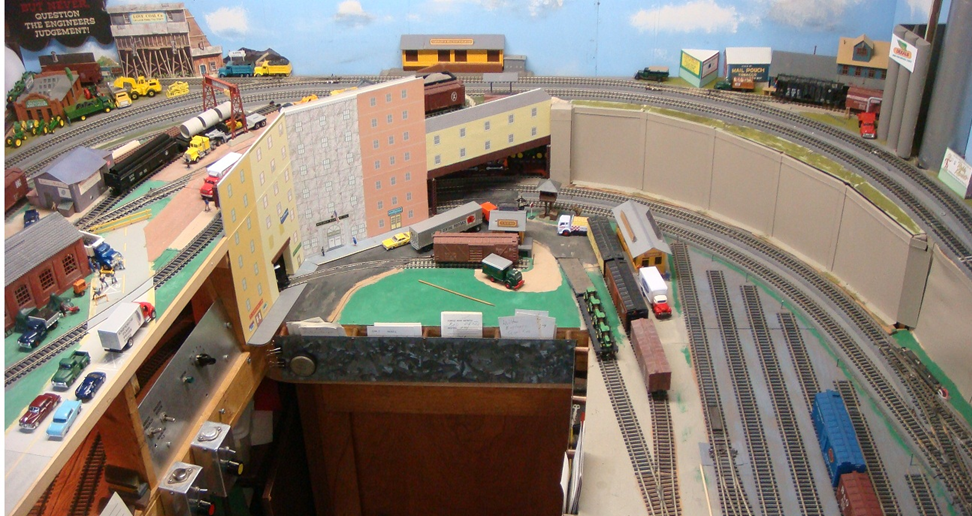
In the upper left corner of this view is the Yardley Freight station with a bit of Hillton Junction above it. The Yardley Passenger Station is cut into the concrete wall (painted paper) beneath the steel panel bridge. In front is the aluminum baking pan control panel for the yard turnouts and block power selection. A homemade handheld throttle is hanging on a screw head in the fascia. The coal dock and water are in the right front corner, those monstrous things take most of any view. A few card system cards for the cars in the yard can be seen in pockets on the fascia to the left of the turnout panel in front of the classification tracks.
These broad distant views show most all of the approximate 90 square foot layout. Remember, the operation pit takes away about 12 square feet – but double decking returns more than that. All this plus a small work bench fits in a room 11×12 feet.
This view is of the left end of the layout which spans six feet. The left of the picture shows a bit of Hillton Industries about one inch higher than the mainline. Hillton Junction is the top level background of the photo with the Edgeport Tractor Emporium on the left and Love Coal Co tipple behind it. Further to the right is the Hillton Junction Station building and Cobb Corn Co. Feed Mill with the grain silos at the far right. The tall buildings of Holden City are in the center.
 Model Railroading on the Cheap
Leave a comment