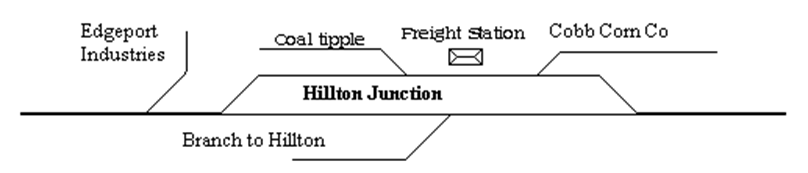
The drawing at the top of this page shows a schematic representation of the tracks in town. Operation here is straight up, easily seen and accessed from inside the pit. The turnouts for the passing siding are powered from the overhead mainline block control panel. The turnouts for the industry spur tracks are manually thrown (until I get more wire from the overhead panel). The plastic structures represent concrete grain storage silos, a feed mill, and a line-side business. The coal tipple is a Walther’s cut out paper flat mounted to a board so as to stand against the wall.
The railroad station here is a modified Bachman kit that I cut in half to make it narrower to fit against the near-by wall, (still providing track clearance) and then stretched it out longer. It only looks good in a photo that is dead straight on. The sign on top was printed with the computer.
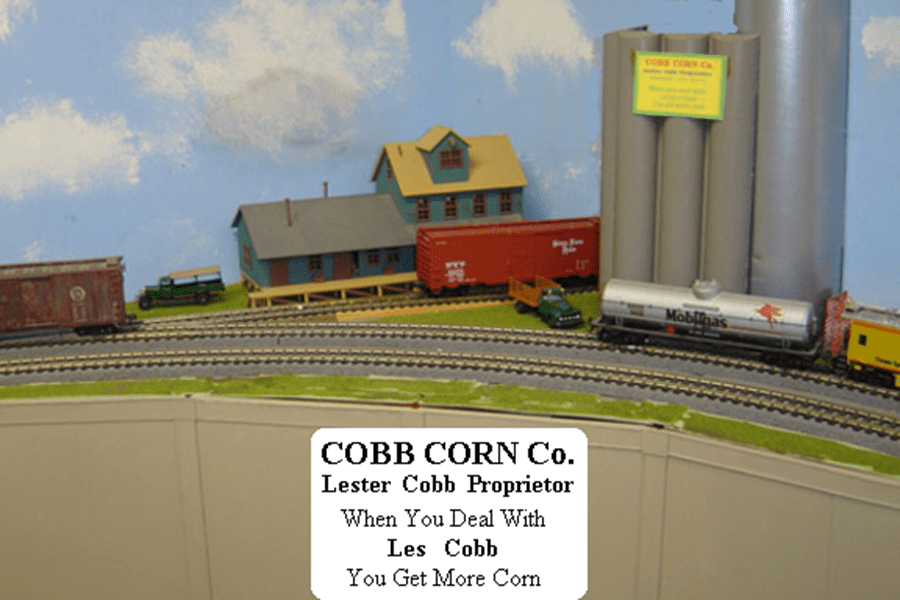
Hillton Junction is the largest passing siding community served by the Y&H with 3 industrial spur tracks. It therefore has the largest freight station (4 doors). It is also where the branch line to Hillton leaves the mainline. As for industries, there is a gristmill and grain elevator in the far corner that I call the Cobb Corn Co. (Lester Cobb – Proprietor) whose slogan is: When you deal with Les Cobb – you get more corn! Here there is a car capacity of 2 boxcars. There is a Domestic coal tipple in the other corner, car capacity of 2 or 3 hopper cars. I named it after a retail coal dealer from long ago memories called Love Coal Co. The slogan on their trucks: ‘Let Love Keep You Warm’. These two industries provide for both facing and trailing point spur tracks for challenging operation. Also at the front table edge of one corner is Edgeport Industries, a small fabrication works with room for one or two cars but it is serviced from the main line. They have recently changed their business plan more toward farm tractors. The runaround for it can be made at Hillton Junction if necessary. This town can be switched by a train from either the mainline or from the branch at Hillton if a variety of operation is desired.

In these photos one can see my hand painted sky board backdrop panels resting on the layout frame and leaning against the room wall. Spacious geography for scenery with rolling hills, shade trees, roads and buildings is not in train my room, so I crammed as much railroad as I could into less than 100 square feet of floor space. This end of the layout spans just 6 feet, but I managed to get 3 industries and a freight station into it by using both corners of the table. Here is a photo of the Edgeport Industries, a small fabrication business with rail service and a spur of 2 cars capacity. The coal tipple behind it is a Walther’s paper building flat mounted on a board to stand against the wall. Many years ago coal was used to heat most homes and there were coal delivery businesses in almost every town. With space so limited, I used most all of the table area for railroad. One must settle for few highways and no parking lots.
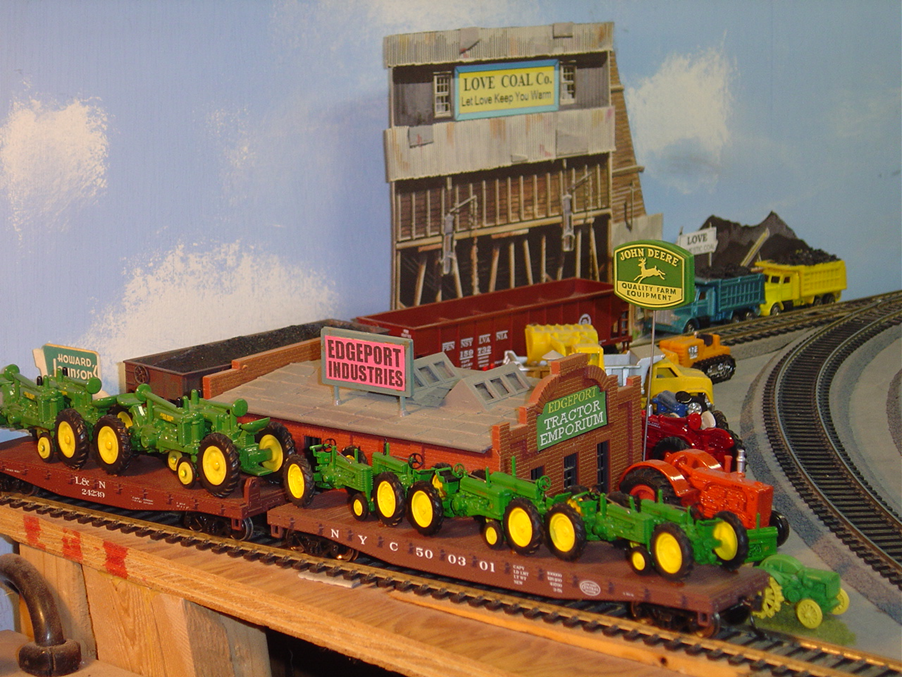
Being raised on a farm I am familiar with tractors. My first job after high school touched them in an off the farm setting at the local International Harvester dealer. Today I enjoy making scenes that are reminiscent of life as a teenager when memories we make can last a lifetime.
 Model Railroading on the Cheap
Leave a comment