How I arrived with this scenery turns into a long story. This area of the layout has been re-done at least three times, either because of method failure (pasting printed paper building flats onto cardboard that warped over time) or that a better idea has surfaced, I guess I continue to learn by doing. It has taken a few tries here to get sensible scenery. Vertical scenery takes up no valuable table space.
Double decked layouts often have trouble making believable scenery where the terrain transitions from one level to two. To solve this problem I used vertical scenery in the form of tall down town city building flats, eight inches high, but I still was not happy with what could be seen on top of those tall buildings (rail cars, vehicles and buildings on the upper level) when viewed from within the operation pit. My tall buildings needed to be taller. By making those tall buildings two stories taller and printing industry flats for Hillton on the back sides of them and re-arranging some tracks on the upper level made me a lot happier and gave me more industries to switch on the upper deck.
There still was the problem of the ‘edge of the earth’ on the upper deck when looking toward the operation pit from outside the layout. Making a highway with a low curb along one edge helped to make this aspect much more tolerable. (See page 81.) It now is a good place to display some of those nice 1950s era vehicles recently available. The other end of the pit has a bigger problem but it is not as noticeable from the outside and my eye is blind the fact that just behind the RR Hotel near the Hillton big bridge is a drop off cliff and the roundhouse below nearby . Eventually I got to where I am pleased with the scenery here at Holden City.
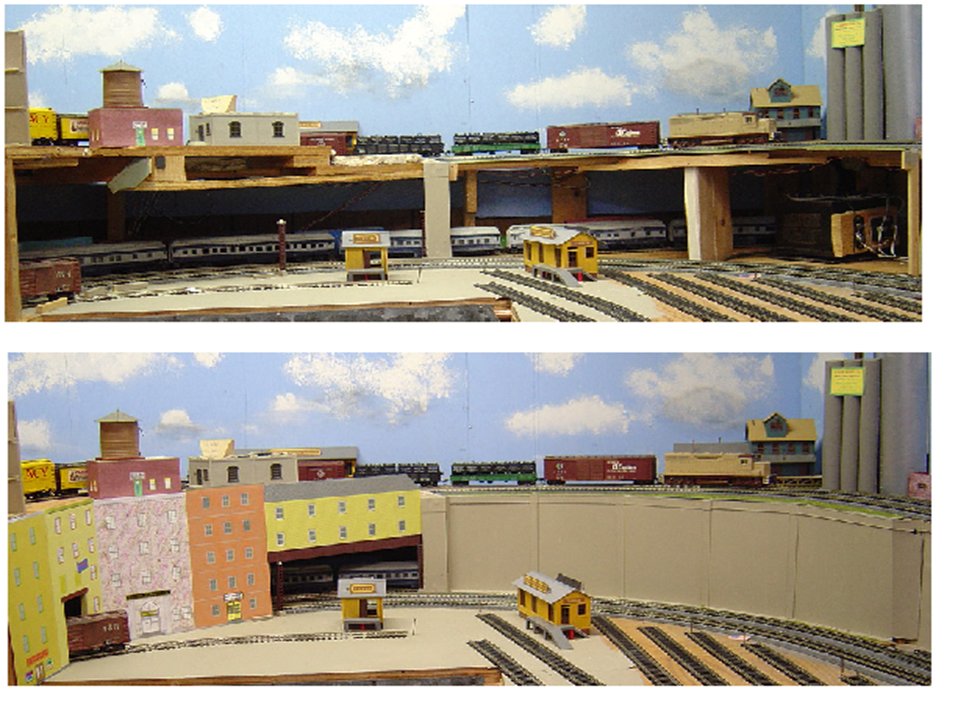
The tall buildings (see photos on next page) are mounted on two removable 1/16 inch thick pieces of vinyl resting on the tabletop, the ‘concrete retaining wall’ is made from heavy card panels glued to curved double layer pieces of card board base sections. All of these sections rest on the table (to resist gravity) and are held in place with a magnet near the tops. The center section has an opening for the mainline tracks to pass below the steel panel bridge, the right end of which is supported by a ‘steel lattice-work leg’ to the table. The left section has the ‘hole in the wall’ for switcher access to the tiny Holden freight station behind the red box car and Railway Express Truck on the lower level. The bench work for the upper level here consists of terraced layers of plywood scraps and a few vertical supports to the table. Page 48 shows pictures of what the vertical scenery accomplishes. I think that if I would have used commercially available building pieces this all would have had better detail. But I was trying to stay cheap, I had more time than money, and if it was good enough for the camera, who needs more? Pictures of the original effort follow next.
Original Holden City Scenery
About vertical scenery at Holden City and how to hide ugly bench work
I realized late in the game that if Holden (visible only from inside the operation pit) were going to have any scenery, it would be at the end of my newfound switcher pocket track extension. Here I had the same problem that several modelers have of how to deal with the scenery where the bench work transitions from single to bi-level. I had track on two levels, the upper being 8 inches above the table. Part of it could be concealed but all of it had to be accessible at times. The bench work was absolutely ugly as far as scenery was concerned. I puzzled how to hide that transition space. I thought I would try vertical scenery. The photos show the view before with the passenger train on the hidden interchange track and the old Lionel transformer, which is the power supply for Yardley. The after shot shows the flat front buildings of Holden, and the concrete embankment wall that hides most of the ugliness. The upper level buildings are actually in Hillton and Hillton Junction. The lower right foreground is the Yardley Freight Station and tracks of the yard.
Creating vertical scenery:
Describing the how and why of the tall downtown buildings in Holden City.
There are 4 major buildings here in the metropolis of down town Holden. I wanted to include buildings that were important to life in most any small town in a time before strip malls and shopping plazas. I wanted a familiar department store, a restaurant, an office building, and a bank. I used the home computer, its entry-level software, and color ink printer to make the flat front buildings. They were printed on card stock paper, cut to size with scissors, and pasted to a thin plastic board held in place with a magnet mounted on the bench work framing and a thin piece of steel glued to the back of the scenery panel. That makes for easy removal to retrieve a derailment if necessary. I spent many hours getting the size and proportion of these false buildings correct, but the only cost was time, glue, card stock paper and a supporting board. For that I used a 1/16-inch sheet of plastic after my first attempt using white glue and cardboard warped in time. But white glue did not hold to the plastic so I ended up using Walther’s Goo to fasten the card stock paper buildings to the plastic panels. This is probably better than water based glue, which tends to warp the paper. In the end I modified the sizes of all the buildings and did them all over again two stories taller. (Making them now over 11 inches tall).
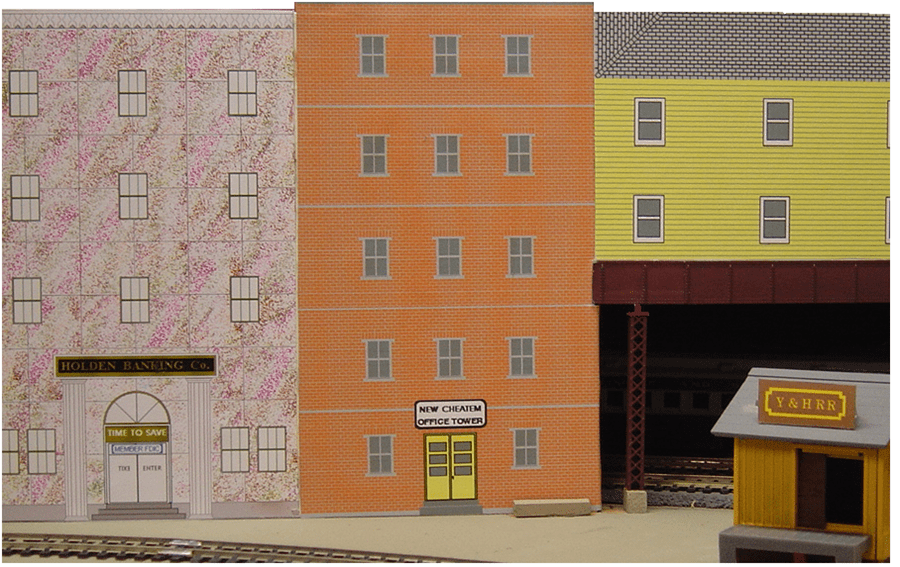
Favorite downtown businesses: Explaining the tall buildings in Holden City:
Everyone has heard of the ‘Local Five and Dime’ so naturally I wanted one on my layout. It is a multi-story retail department store like those in many towns in a time before shopping malls. All of these building flats are smaller than a sheet of paper so they can be printed with a home computer printer. I changed the window styles of some of these buildings and the brick color for variety.
The restaurant building, (reinforced with a steel beam), has the only remaining door to ground level in the front of the structure that was ravaged by the advances of the railroad. (a track through a brick wall?) They serve good food in the rear. Its upper floors are rented to Dr. Pulmor the dentist, Fat Albert’s Dance studio for young girls, Willey Katchem Private Detective, and the part time offices of a local political party.
The bank is a really nice looking building with exotic polished pink marble facing. I wanted to do something special here as banks and office buildings were an important part in the life of a business machine service technician. Here the Holden Banking Co. proudly displays its name and an American Flag on a gold lettered sign atop its pillared entrance. After printing several styles of brick and clapboard siding for most buildings, I wanted something special for the bank, so I tried my hand at creating marble for the bank. I used the Paint program to spray various colors onto a separate panel, then used cut and paste to copy parts of the panel onto the wall of the bank. Assembling my small panels on the computer screen was easy. There are no two of these marble panels exactly alike. I then printed it on glossy paper to get that clean shinny look.
The Cheatem Realty Office building is of conventional brick mask overlay. The renting of office space has been so lucrative here that when the railroad wanted to sell an unused steel bridge next door for scrap, Mr. Cheatem bought it with the intention of using it for office space. He had a two-story wooden office building built upon it. Access to the new space was through one of the rooms off the 3rd and 4th floor hallway in his original building. However it seems that tenants don’t stay long in the new offices. They complain that it is cold, drafty and hard to heat in the winter, the windows are too small for good light and the offices are too noisy for telephone conversation when a freight train passes beneath it. So much for a good idea poorly executed.
As I mentioned earlier the price of real estate space here in Holden must have been quite expensive to justify such a concocted story to support such a drastic effort at scenery. I know that in real life such extreme measures would not be taken, but when a desperate modeler with a creative imagination is pressed for building space in a crowded train room, such things might happen.
When viewing the photographs of this metropolis with its tall buildings and concrete pavement, the tiny little Y&H Freight Station certainly looks out of place amidst those tall buildings. One can only wonder how and why that little freight station has survived. Perhaps it is because it serves better as a place for the crew of the Yardley switch engine to warm their gloves and water their whistle than the little bit of freight carried by the 40 foot cars that it handles. Car length here is restricted by the too sharp curve leading through the “hole in the wall” to the freight station.
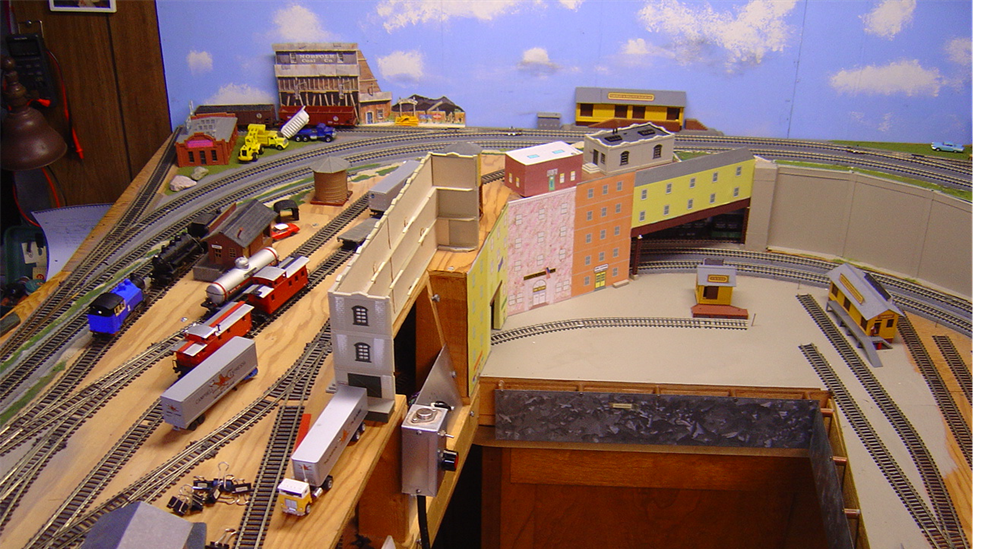
The photo above view shows my original efforts with the flawed logic. The tall buildings needed to be taller. This gave reason for rearranging tracks on the upper level. That turned out to be the best idea yet and really opened the area on both levels for growth and more freight traffic.
Commerce Street offers new scenery opportunities:
After the vertical buildings were finished at Holden City I thought that perhaps a street and sidewalk would look nice in front of these buildings and help hide the plywood. I had a gray colored piece of plastic sidewalk left over from a kit building some other where on the layout. It had a nice curved end and molded joint lines but it was too short and the curve was the wrong hand. So, I laid it face down on the scanner and made a copy into the computer. Then with software one can flip this graphic to put the curve on the correct end and I printed the curb in front of the bank building yellow color indicating no parking as the law prohibits parking in front of banks.
This was named Commerce Street in front of the tall buildings. It also provides access for vehicles to the Yardley Freight Station before it turns under the overhead bridge and crosses the mainline into the darkness of the shadows. Here I learned how to pave over train tracks with card stock and paper. I now find myself hunting the hobby shops for suitable automobiles and trucks. The small space across Commerce Street has become known as Holden Green, barely a square foot in area, it provides access to 3 distinct scenes. Namely, Holden City tall buildings, Holden Freight station, and Yardley Freight station- team track. Hopefully, with careful use of the camera, to show only one of these scenes at a time, it can provide a few more points of interest for the photographer. Years later it was space for new activities and growth! Someday I will electrify the rail crossing flashers with automatic solid state timer controlled LEDs.
Showing the original track and structure arrangement with flawed logic.
These two photos illustrate the flawed logic of the industries and track arrangements with which I was never comfortable. After closure of the hole in the table-work and elimination of the Crammedin Warehouse (given to a friend) on the upper level things worked better on both levels. I was able to have the tracks better aligned to suit the buildings they served.


Recent Views of Holden City

The new with and without tall buildings photos illustrate the value of double face buildings. The blank white panel on steel angle brackets in the middle of the upper level is the backside of the Mirage Warehouse in Hillton on the upper level. Here I learned that the upper level building flats could be pasted directly onto the backs of the tall city flats. The angle brackets are unnecessary. Another lesson learned.
I have a feeling that building these flat store fronts would have been easier if I would have used materials such as those offered by Design Preservation Models or the like. But I had more time than money so I persevered with the computer and its accompanying software, and printing each one at least 3 or 4 times. I had a real problem with how to deal with where the switcher pocket track came through a brick wall to serve the Holden freight agent. It is really not very prototypical, but I did it anyway, and I am not sorry. I have included a couple close-up shots of what has turned out to be the largest section of ‘downtown’ on the entire layout. The creating of these flat front buildings and the imaginative writing about their justification has been lots of challenging fun.
 Model Railroading on the Cheap
Leave a comment