All the photos in this chapter were taken while standing in the 2×6 foot operation pit.
Holden Train Staging (located directly below Hillton) is hidden from spectator view and is only accessible from inside the operation pit at Yardley. It is a 4 track hidden storage / train staging yard. It holds 4 trains ready to go for either direction if desired. Track power is from either the Yardley throttle or a mainline A or B throttle. It was not shown on the original published track plan, but after operating this layout for a while, the real value of staging becomes more apparent. It seems such a nice addition; I am glad that I built it. To verify the functionality of the track work I tested it with vigorous speed, pushing and pulling strings of cars before covering it with the upper deck of Hillton.
Included here are 3 photographs showing the 8-inch vertical clearance for the staging tracks below Hillton. In the view below we see some vertical supports and wires for Hillton, the backside of broken ceiling tile ‘rocks’ and the 4 double-ended tracks of Holden. The track to the left in the foreground is the approach for the Yardley classification drill or engine service track, to the right is switcher pocket and to Holden Freight Agent.
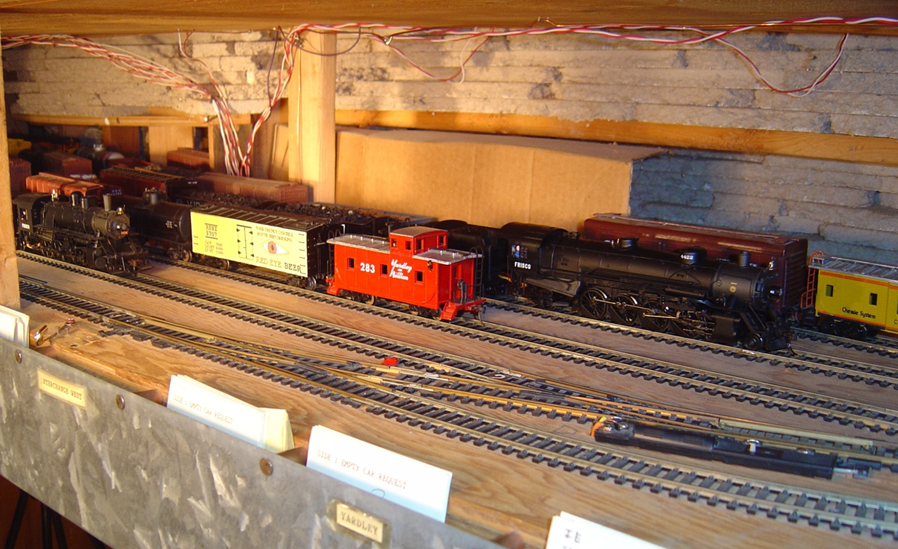
A switcher pocket is a handy thing to have at the far end of the drill track in a classification yard. This can be a temporary resting spot for the yard switch engine that could be used to shove a cut of cars up the drill track that had been left on the yard approach track by the road engine, which had headed for the barn. I use a manually thrown turnout for the switcher pocket; this also cuts power to that track when not in use so an engine can sit there while the yard throttle is doing something else.

The Holden Staging Yard (schematic shown at the bottom of the above drawing) is not well suited to sorting cars. The left (while in the pit) approach track is too short, only long enough for a switcher. The right (east) approach track has a capacity of about 8 cars and a switcher engine before fouling the main line passing siding. Holden has no power supply, only a small control panel for throttle power source selection (main line A or B or the yard throttle) and the rotary route (one of five) selector switch. The overhead clearance of 8 inches and track spacing of 3 inches is sufficient for one’s hand to correct the occasional derailment that might occur during operation.
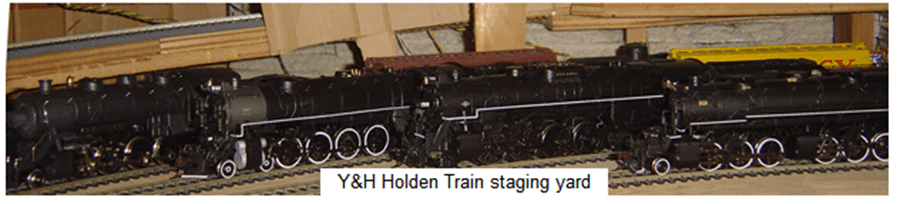
Let me define train staging after learning from operating with the freight car forwarding system. At first I had assumed that train staging meant that we stored a train ready to go to a planned route or destination. I guess that is still true. But after actual operation I found that it is just a handy place to temporarily store a train with which I am not quite ready to handle. It may be a string of cars that the yard switcher is too busy for at the moment or it is a train that is made up and ready to go but not at this moment. You don’t want to send a train for Hillton out on the main before the Hillton man has readied his shipping cars and has them setting on the outer pass there. The best thing that staging does is to take a bit of pressure off of the yardman who is usually busy while the Hillton man should be readying his cars for the Hillton Turn. It really is handy for train storage either long term or short. Recently I tried a new photo of Holden Staging, see below. Eventually I discovered a way to illuminate this dark area, documented on page 27.
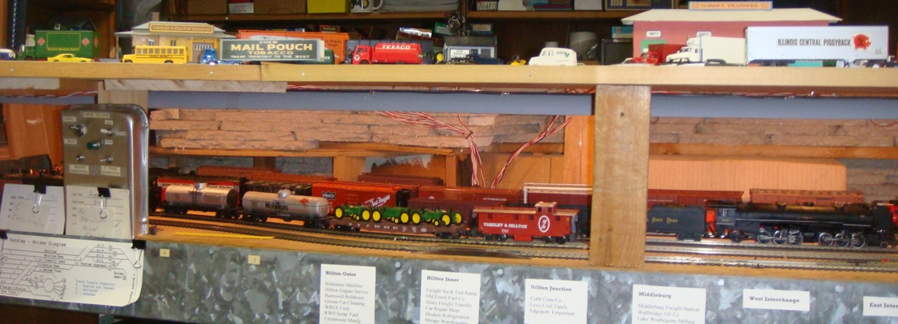
Holden Staging Yard is located directly below Hillton:
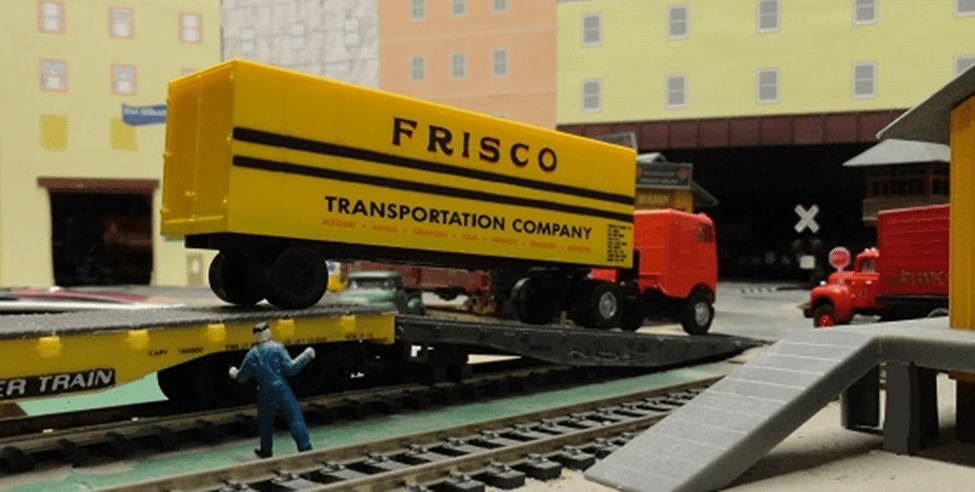
Long after I had the railroad running it occurred to me that just another couple feet of track added to the switcher pocket would reach a new station and grow the railroad a bit. After building the Holden staging – holding tracks and getting them into operation, it seemed so natural to extend the switcher pocket track to a small station for a freight agent at Holden City. I had just discovered a new source for traffic! Sometimes things develop as after thoughts. When space is short, vertical scenery and flat buildings are required. That is how the tiny station for the freight agent at Holden came into being. It generates an occasional boxcar of Railway Express traffic handled by the Yardley switcher.
 Model Railroading on the Cheap
Leave a comment