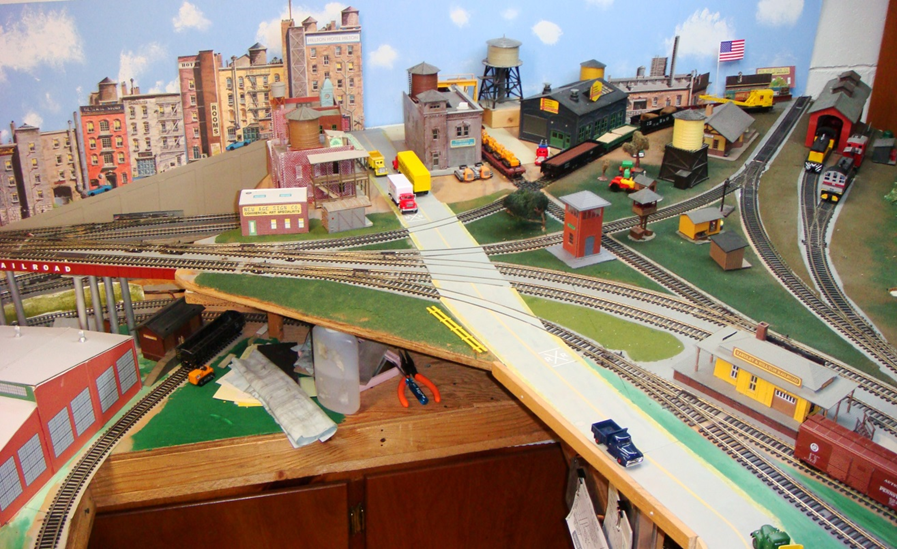
In this view of the left end of Hillton, the far left and background is Hillton Junction with the Cobb feed mill barely visible in the distance. Toward the right and elevated is the Mirage Warehouse and a multi-purpose track. Just beyond the hopper car is the passenger shelter for Hillton Junction passengers boarding from the passing track. The track entering the foreground from the left is the branch to Hillton. The gondola in the lower right corner is on the heavy materials track with an overhead crane straddling both the spur track and a lowboy flat-bed truck behind the machine shop out of view near the gondola.

The dual purpose track in front of the box cars can be used by hopper cars for bulk material or by the warehouse to double its capacity. Here today at the lower end of Hillton we see the bulk material track with the conveyor and a half unloaded hopper of gravel and a half loaded dump truck to haul it away. In the background is the Mirage Warehouse.
About the multi-purpose track to the left at Mirage Warehouse; Years ago when most freight was handled in boxcars, warehouses in crowded cities with busy freight traffic would sometimes have a second parallel track to allow the loading of two box cars from one warehouse door. This was done by using temporary bridge plates between two boxcars both with opened doors. With such a scheme we can have four cars loaded from two warehouse doors by working through the first car and into the one on the second track.
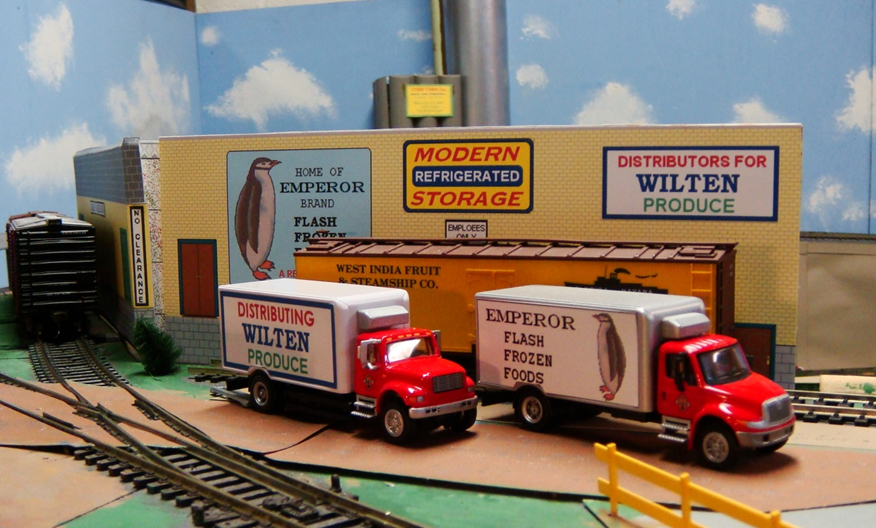
This shows how I got another industry that takes practically no table space right at the edge of the table by using double face building flats and it can accommodate both trucks and refrigerated rail cars. Both these industries are pasted onto the backs of the tall store flats along Commerce Street in Holden City on the lower level. I am pleased that this small industry can handle both rail cars and highway trucks. The illusion with flat buildings works best at near eye level. All it takes is an imagination with a time span of history that is flexible. Freelancing tolerates these modern refrigerated trucks that are too new to be seen with old time ice cooled refrigerator cars.
Below on the next page we can see about half of the Hillton industries and a good view of the “Y” track. The hand painted sky board background with the familiar Walthers ‘back streets’ paper building flats cut apart to allow staggered arrangement down the sloping street. Here at Hillton I made paved streets by printing them on post card stock paper and gluing them to the plywood. That is a cheap and easy way to get a sharp yellow line in the middle of the street and the RxR warning on the pavement in advance of a rail crossing. Now I have a way to show some of those nice 1950s era cars and trucks now available.
My writings are not intended to show fine quality modeling but rather to illustrate ideas and methods to get lots of operation into a room sized layout. I believe that realistic operation should not require expensive scenery. These writings are more about sharing with others some of the challenges and enjoyment found in this great hobby. I did not want to spend a lot of money on layout furnishings. I believe that with this hobby cheap hand crafting can be just as much fun as first class store bought stuff.
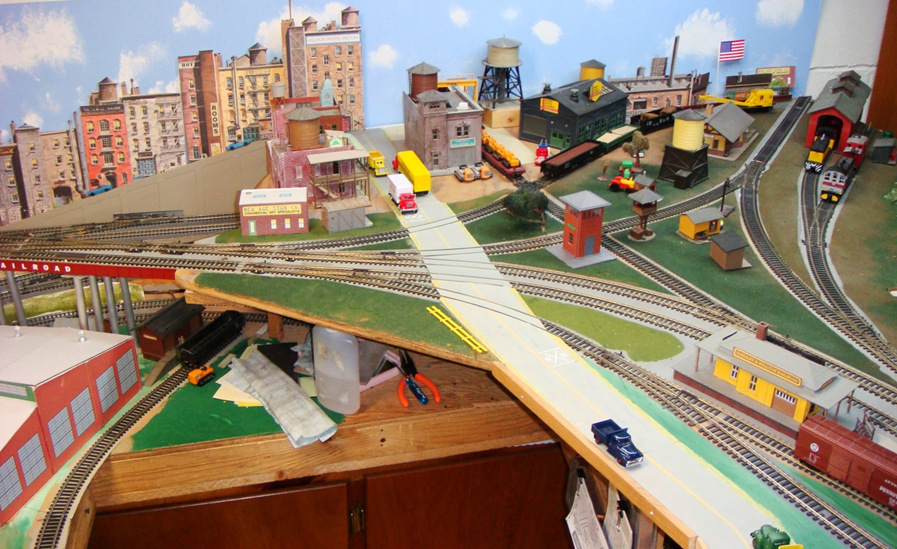
At the top right corner is Hillton’s single stall engine house and service track with the ‘fun to use’ “Y” tail track, with automatic tail track polarity reversal, to turn locomotives for the return trip down the branch to the Hillton Junction connection with the mainline. Toward the left is the Western Railway Equipment Experimenters facility, responsible for feasibility work on alternative designs of railroad equipment for subscriber railroads (some folks may call this ‘kit bashing’) and the Ramswell bulldozer factory. I enjoy hauling heavy equipment like tractors and bulldozers on flat cars where you can see some colorful and interesting loads.
In the lower right corner of the picture is the combination freight and passenger station and team track. The tracks extending toward the left use the Hillton big bridge (that goes nowhere). The Yardley roundhouse and Underhill Fabricators are on the level below. Also seen is a bottle of alcohol and a rag for cleaning track and car wheels, shame on the photographer’s carelessness.
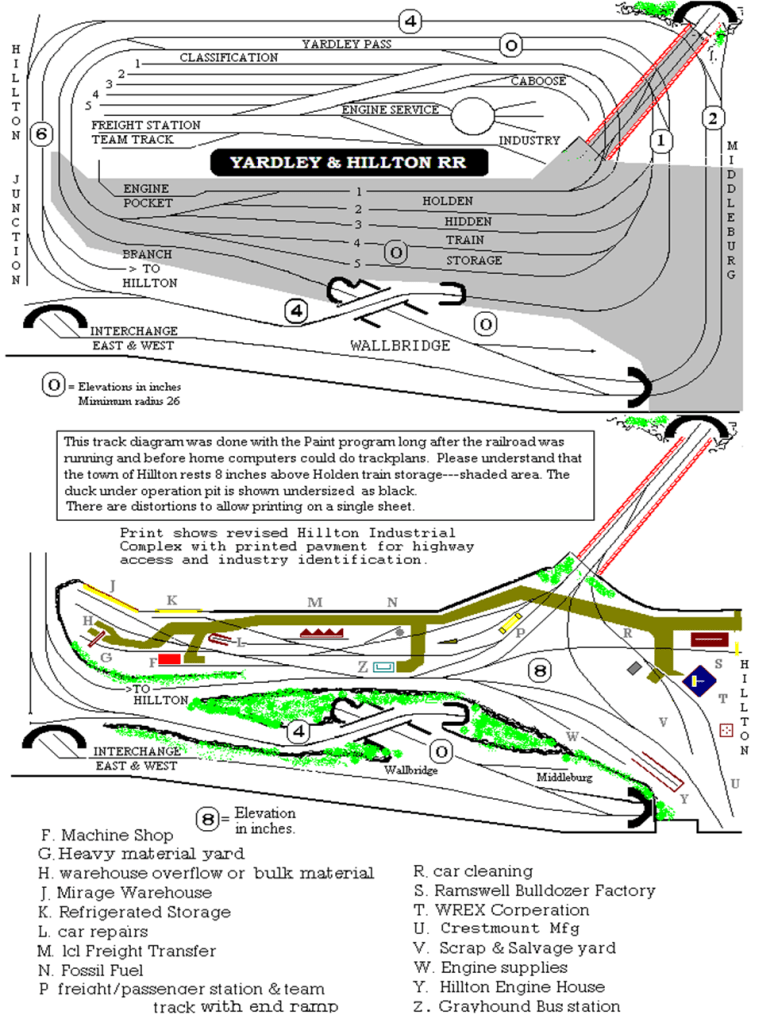
The railroad track plan (on the last page) is a two lap grade-separated crossing oval of 60 running feet. The mainline has three passing sidings each long enough to hold about 10 cars with engine and caboose. The layout has 58 turnouts yet takes less than 100 square feet of floor space. It can accommodate two operators, though I am usually alone. I use conventional DC control with homemade tethered transistor throttles because I like the way they work. I prefer steam locomotives for mainline freight service and short diesel switchers in the yards.
I believe the strong features of the layout are the easy to use classification yard at Yardley, the industrial switching area of Hillton on a raised pedestal for easy access and view, and the staging tracks of Holden easily out-weigh the duck under access to the operation pit.
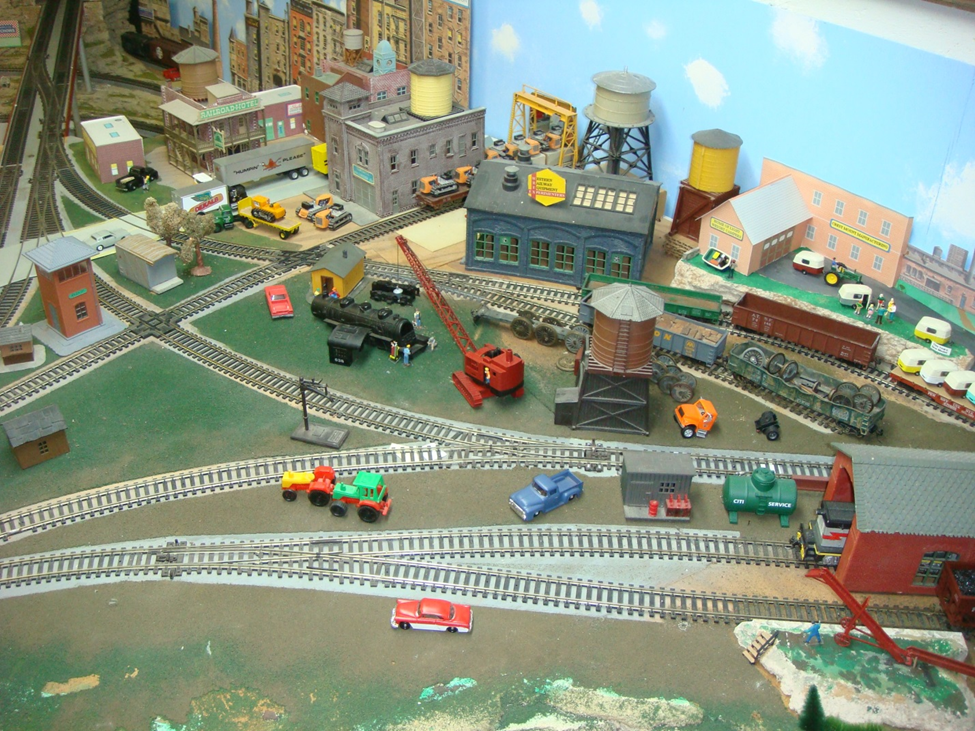
This end of Hillton has been changed recently by elimination of that seldom used passenger station. Now we can handle even more industrial traffic. The new industries are the travel trailer factory which ships light weight trailers loaded on flat cars and the expanded scrap yard with their new larger crawler born crane and spur track now on the near side of the wood board fence just out if view to the right. Of course the Ramswell bulldozer factory is still here with the mirror beneath the yellow frame crane multiplying bull dozer production. The large blue building is the WREX facility; they need an occasional car. We see a glimpse of the conveyors for loading coal into locomotives on the engine house service track in the lower right corner. There is even a phantom industry (car cleaning service) by the black pickup truck near the RR Hotel that can take a car with no building or loading dock! I counted track car capacities while writing this description. The five mainline industries can hold 10 or 11 cars. The two hidden Interchange tracks can take about 12 each. The Yardley classification yard will hold about 25 cars; its industries 6 cars and Holden staging tracks have a capacity of 30 cars with 4 locomotives and cabooses. The industrial town of Hillton takes at least 18 cars at over a dozen locations, quite impressive traffic for a room-sized layout. That all adds up to over 100 freight cars, although operation works better with 75 or 80 cars.
 Model Railroading on the Cheap
Leave a comment