My double-ended staging yard is over 7 feet long and 5 tracks wide with an overhead clearance of just 8 inches. It has always been a bit dark to see what cars were under there. Finally after years of wondering how to get some light on it, without having it shine in your own eyes, I struck upon an idea that worked quite well, by using a length of 1 1/2 inch plastic pipe to mount low voltage lamp bulbs like those used in ornamental lawn lighting. This lampshade is about 6 feet long and supports ten 12-volt lamps wired in parallel and is powered from unused train power supply voltage. These lamps have no socket so I soldered them directly to the 18 gauge copper wire so that the wire supports the lamp. The photo shows a portion of my lampshade with lamps mounted and wired.
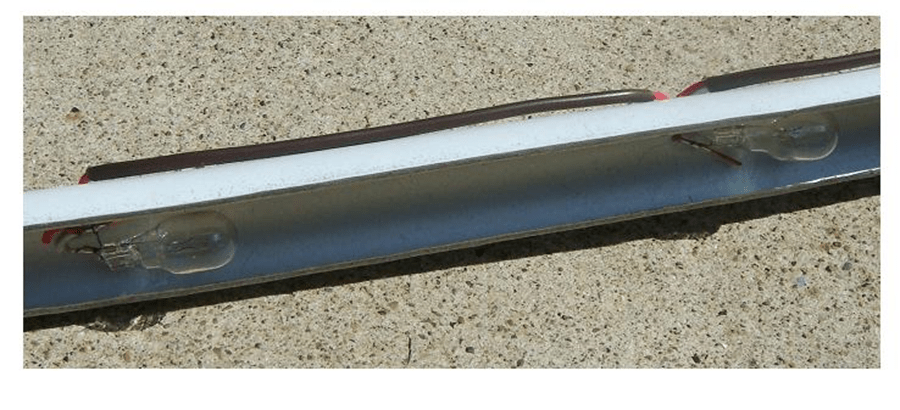
A split length of 1 ½ inch plastic pipe serves both as a reflector and lamp mounting. I puzzled how to split this pipe. I thought I could cut it with the skill saw if I could keep it held firm and straight during the cutting process. I made a fixture of scrap wood and a strong straight 2×4 to hold the pipe in proper alignment while cutting it with a skill saw. First I drilled a couple holes in this pipe to fasten the pipe to my fixture and used the same holes to mount the pipe to the overhead plywood above the yard. I intended to split the pipe about in half lengthwise, then use the small half for the lampshade and mount the lamps directly to it. The temporary fixture worked OK during the sawing, but the plastic sawdust went everywhere and was a chore to clean up, much more so than wood.
After the cutting I sprayed a coat of aluminum paint on the inside of my split pipe, then drilled a pair of small holes for each lamp. I strung wires on the outside of the shade to each lamp position. The lamps I used were modern wedge base type with no socket, just a pair of wire leads bent over the end of the glass. I lifted these leads away from the glass and scrapped them clean for soldering to my 18 gauge copper pair running parallel to each lamp position. That seems to hold the lamps well enough for support.
I used 4-watt lamps and powered them with unused AC voltage from one of my transformers. Ten lamps at 12 volts draw 2.7 amps. (I later used a separate transformer to supply this voltage). Doing this did not harm the performance of my 100-watt train supply transformer. These lamps really brighten the dark shadows so one can see the cars on the 4 tracks a lot better. The lamps are nearly hidden in the lampshade, which hangs down about an inch below the overhead deck so a hand can still reach in for the occasional derailment.
 Model Railroading on the Cheap
Leave a comment