The use of mirrors can sometimes be rewarding if you are able to do it right. It takes some planning and practice. Here I tell of what I have learned of the subject.
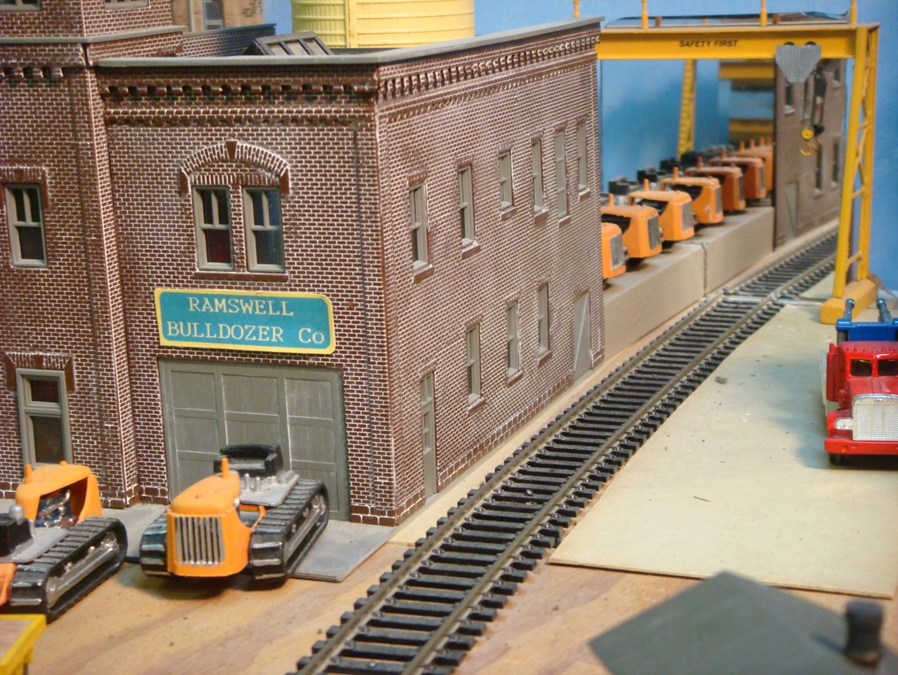
Here is the Ramswell Bulldozer Factory located on the top level of my layout against the wall of the train room. Note the many bulldozers awaiting shipment on the loading dock at the rear of the building. (Try counting the bulldozer exhaust stacks). The building was originally a plastic Fire House kit, the tall corner of which was used for hanging fabric water hoses to dry. To simulate mortar in the joints between the bricks, the walls of this building were coated with white water based paint and most of it quickly wiped off with a wet sponge.
The track alongside of the building is slightly curved as it heads toward the wall. The mirror at the end of the track is square with the track, the top and side edges of this mirror are hidden by the yellow overhead crane. There is another mirror replacing the back wall of the building. This second mirror is not square with the building. The loading dock (a wood block painted concrete gray) fills the space between the mirrors. For this type of illusion to be effective the observer or camera must stand in just the right place.
I learned of this illusion by reading of the work done by John Allen back in the 1950s. Some important considerations for this type of illusion trick to work are to limit the viewer’s range, to never allow the viewer to see himself in the mirror, and to hide the edges of the mirror. Mirrors nearly parallel to each other can pass an image back and forth between them so as to multiply the image of an object between them. In this scene the viewer is about 4 feet away from the wall.
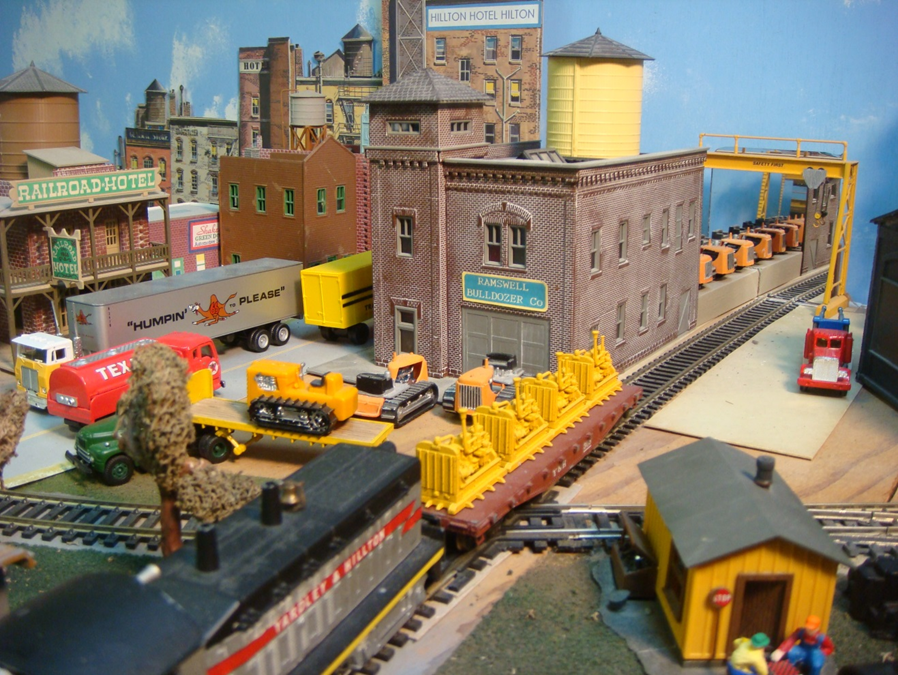
In the scenes below, I moved the camera to show location of the elements, there is an empty black gondola on the track to the right of the building. The placement of other buildings and the wall of the train room can be seen. I used flat paper buildings (some are Walthers Back Streets) along the wall, and a flat background board painted blue sky blue. The footprint of this scene is 7 inches wide by 12 inches deep from the front of the factory building to the wall behind the yellow overhead crane frame.
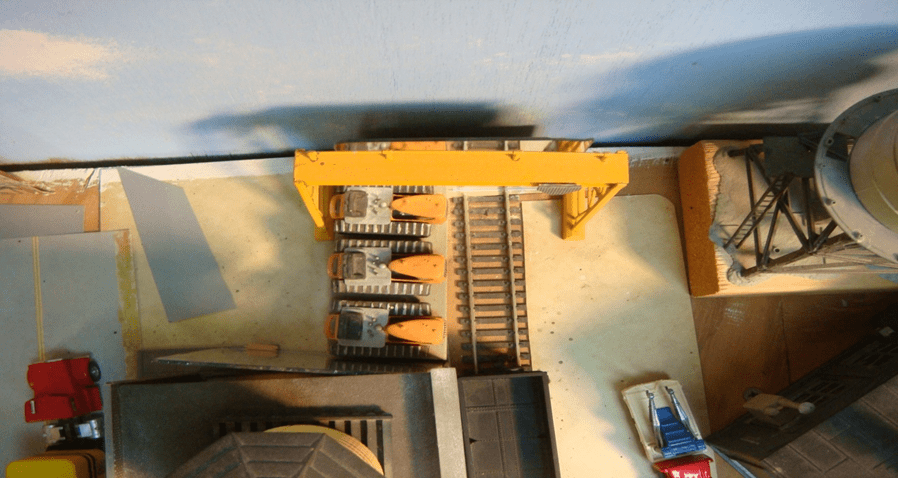
The last view is with the camera directly overhead, to show the placement and angles of the mirrors. The track end mirror can be seen just above the yellow overhead frame. Note the angle of the mirror on the back of the building. This coordinates with the slight nonalignment of everything, even the loading dock (full of bulldozers) is not square with the track. By having the track and wall and mirrors at a slight angle and on a slight curve of the track, the images do not align directly with each other allowing the observer to see each one of them slightly separated. The visual effect is impressive multiplication of a small scene.
Included here to further your understanding of this illusion are a couple more photos to illustrate the placement of the mirrors.

 Model Railroading on the Cheap
Leave a comment