An old time railroader once remarked to me that when scrap is moving on the railroad, it is the sign of a good economy! There are more stories about scrap operations later in the book.
Not long after the camper factory was in place the Hillton city fathers realized just how little traffic that un-named railroad passenger station was handling and suggested the economic development committee explore new uses for the property. Soon that seldom used passenger station was razed and the resultant brown field became an expanded junkyard with genuine railroad scrap being cut up for recycling.
The newest industrial spur at Hillton serves the Western Industrial Salvage Enterprise. They acquired a new larger crawler born crane to handle larger pieces. This replaces the smaller rail born crane used previously. They even put in a new rail spur after relocating their operation to the near side of the old wood board fence. The net result was another industry better served by rail in Hillton. The towns’ folks are excited to see more rail business come to town. This is one of few towns that values rail service to their many industries, no one ever complains about trains blocking the rail/roadway crossings.
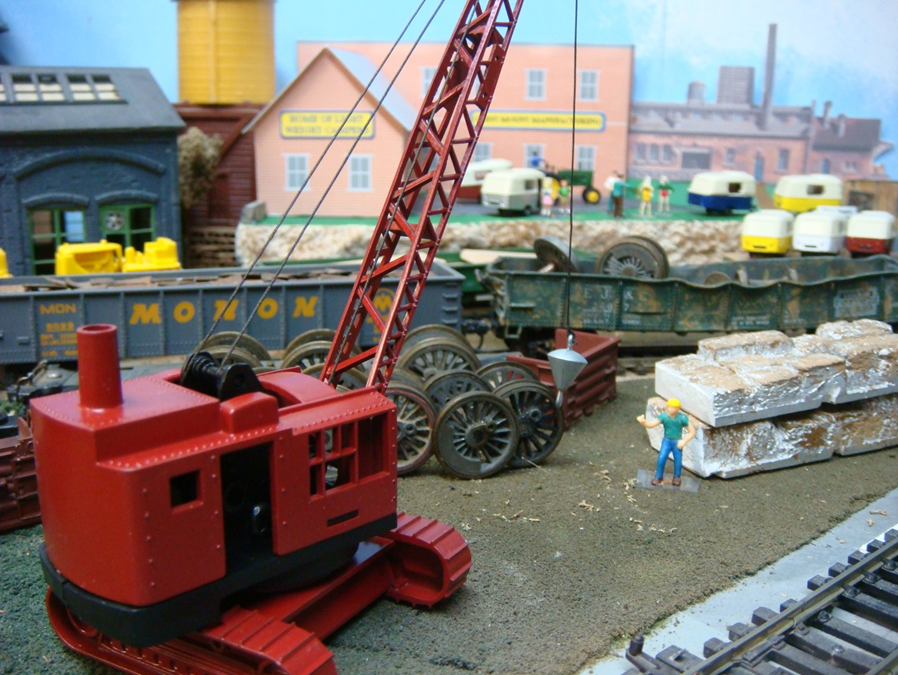
The story of urban renewal continues with the addition of another industrial spur track and the new larger crane to handle the scrap for recycling. This is better utilization of the space formerly occupied by that seldom used passenger station. This track was just out of reach so I powered the Peco turnout with a tabletop mounting of their twin coil motor that was concealed by cutting the bottom out of the old Atlas crossing watchman’s shanty structure and an additional toggle switch on the control panel. A sliver of this shanty can be seen just to the left of the steam locomotive boiler in the bottom-most photo.
Here we see Hillton’s newly expanded facility- the scrap yard has its own rail spur track. It is located where the former un-named railroad passenger station had been for many years. They now have a new larger crawler type crane to handle their growing business instead of the small 25-ton rail born crane originally used. From the looks of that battered gondola car in the picture maybe it will be next to fall under the scrappers torch.
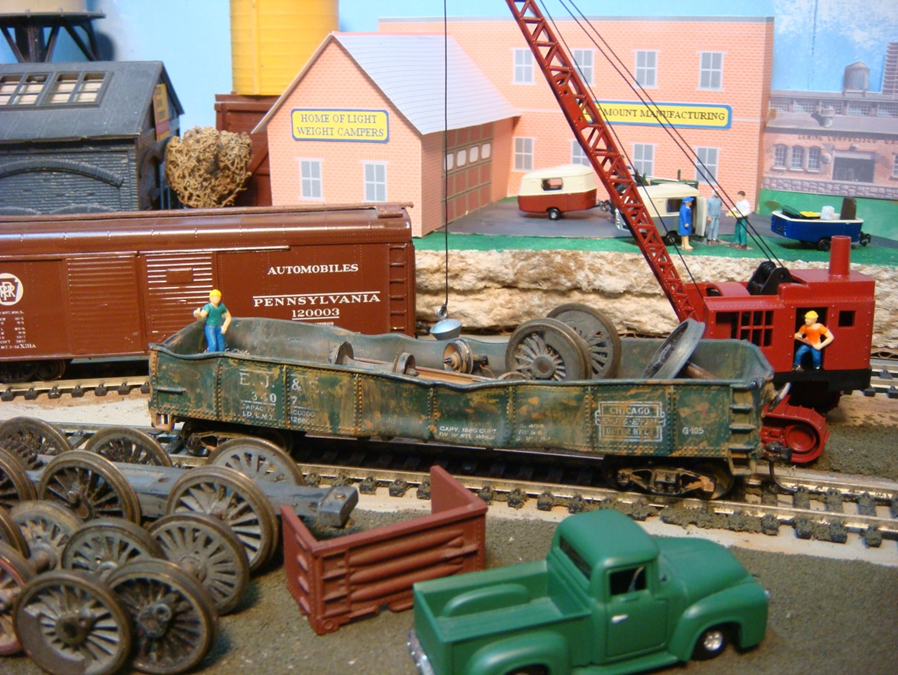
The badly dented gondola above was achieved years ago by working it over the flame of a lighted candle on the work bench to get that badly dented, belly ended, sway backed look so convincing with heavy weathering. I think this method works best with thin walled material. Still one must be careful, there is a hole accidentally burned through the floor of this one, which I covered with a piece of sand paper. I tried this method to get a belly-ended boxcar once that had ends that were thicker than the sidewalls. It did not work well. Also I have tried heating with an electric hair drier to get the plastic to soften, and then briefly push a tool against the side panel to achieve the dent may be of some value.
The crane is a Life Like Scene Masters kit after repainting to make the lattice bracing on the boom more visible and re-stringing with finer gauge braided silk fishing line. The man inside had his foot cut off so he would fit. Sometimes you can make a figure work better by altering its posture. The welders with the cutting torches are from Woodland Scenics. The acetylene tank cart was made with wheels from one of those abundant Crest Mount trailers and bent wire. The sacrificial trailer, with its top removed, is tilted against the factory wall to display its spacious interior! In the distant background of the top-most photo is a glimpse of the compressed (half-sized photocopy) of the Leming Compressed Gas Factory, a Walthers paper flat.

I want to tell how happy I am with this change that eliminated the passenger station and added a scrap yard. I now believe it was a foolish idea to have the Arlee Passenger station here on a track with stubs ends in both directions. It was a structure that I bought early in the dressing of the layout. It never did fit with this industrial town. Scrap yard operations can handle colorful and varied freight traffic. Perhaps we learn by doing!
 Model Railroading on the Cheap
Leave a comment