I like modeling the steam era because of my memories. Today, grain like wheat and corn are shipped in covered hopper cars. In the 1950s the railroads used 40-foot boxcars for this. Some of us remember how grain was shipped in boxcars. Here is my attempt to replicate some of those scenes from my youth in miniature. Some feed mills or grain exchanges had a pipe or chute coming out of their building and into a car on the rail siding nearby. Those buildings might have been called ‘prairie sky scrapers’ — tallest buildings around. Other millers worked off the local railroad provided team track.

I remember firsthand how this was done as my uncle who owned a feed mill bought wheat at harvest time from local farmers and sold it to Pillsbury mills in Buffalo I think for flour for bread. This was done in ‘wheat season’ for just a few weeks in late summer. He worked off the team track a short distance from his mill. He had to take the cars that the railroad provided him, which often meant that he had to patch holes inside when necessary. As I recall in about 1953 double-sheathed cars were steel on the outside and the walls and floor inside were wood. The cars usually came with grain doors to be nailed over both open boxcar doors from the inside before loading with loose grain. These Grain doors were built up from a double or triple layer of wood boards and were about 14 inches tall and long enough to fit across the opened boxcar door. They were stacked about 4 or five high closing the door from the inside up to about 3 feet from the top, held in place with a few nails on their ends.
A few years later paper grain doors were used. These were provided or specified by the receiver to allow for faster unloading at the receiving end. They consisted of a double layer of brown Kraft paper glued together with several steel bands sandwiched in between. There were small holes for nails in the ends of the bands for nailing them in place inside the car across the opening of the door. The steel bands provided the strength required to hold against the pressure of the loose wheat. Wheat can behave a lot like water in large quantities. It is my understanding that for unloading, the outer door was opened and a large mechanical chute was jammed into the opened door piercing the paper and then the whole car was tipped and tilted from one end to the other so the grain would slide out by gravity.
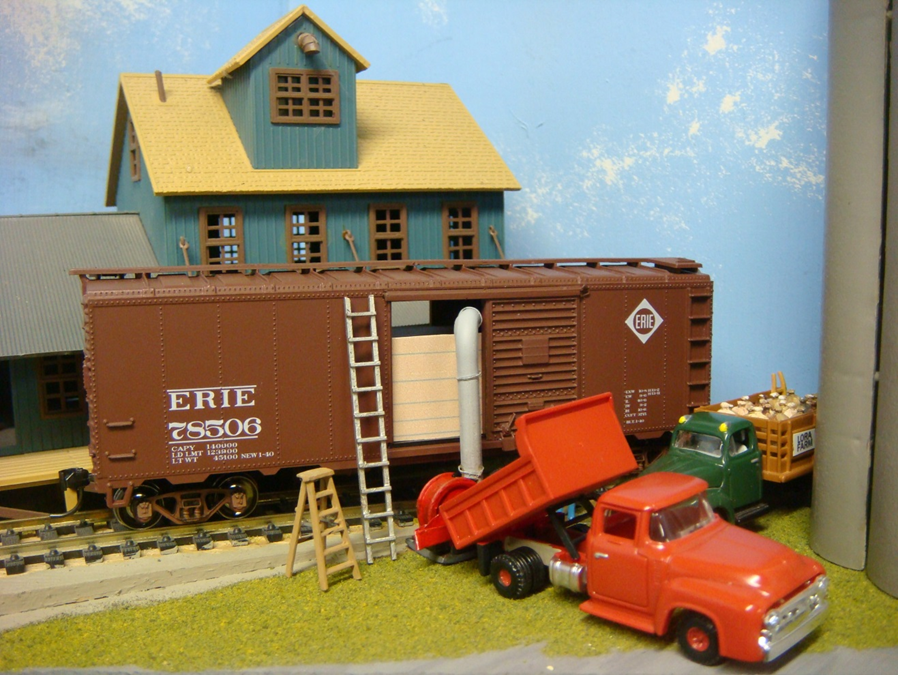
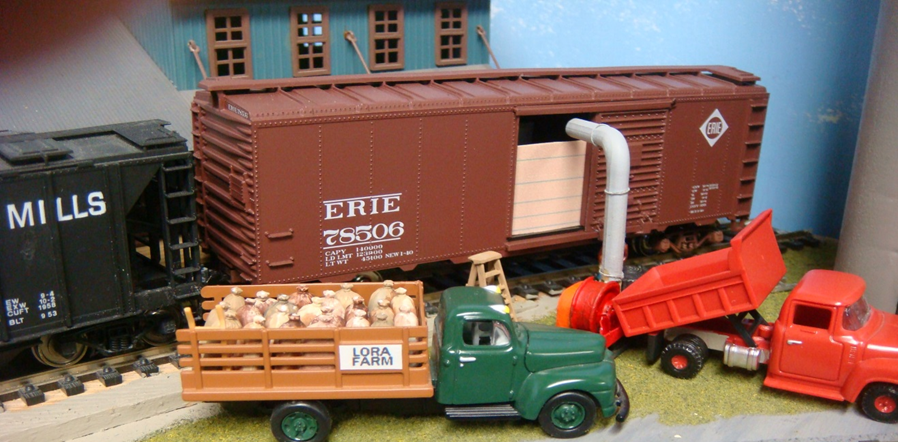
My uncle shipped several cars each season and had a gasoline powered blower to put the wheat in the cars. He could accept the grain from the farmer either in burlap bags off the farmers’ stake body truck and dumped into the blower or loose from a dump truck. Of course these trucks had to be weighed on the scales at the mill both before and after unloading. He carefully tested the moister content of the grain with an electronic instrument because if it was not dry enough it cost him a penalty at the receiving end.
I have attempted to model scenes of this action as I recall from my youth. My efforts required scratch building, as I could not find a suitable blower in 1/87 scale. I did not spend too much time here because it is only for the camera. The details are in the story not in the photograph as the blower is nearly invisible tucked under the car and behind the truck when in operation. The blower was mounted on runners and had to be dragged to the next car when this one was full and dragged out of the way if the railroad came to move cars.
This was dusty, dirty, hot, heavy work and it seemed that one was always in a hurry tending to all the details of this business. Ordering empty cars but not too soon, because there were extra charges to pay if you were too long getting it loaded. Of course you had to make sure the car would not leak your load away in transit. You had to mount the grain doors, which were usually provided but not installed. You had to keep track of your several farmers’ vehicles gross and tare weight and you wrote him a check for the value of the net weight while keeping an eye on the market price and tallied the total weight of the loaded car so you would have an idea of what the buyer would pay you when it arrived at the destination and to not overload the car or the railroad would charge you back for overloading the weight limit of the car.
As I recall the blower was a rotary paddle type fan about 2 feet in diameter, belted to a 5 horse power (I think) rope start air-cooled engine. It had better start on the second or third pull or you would get worried and look in the gasoline tank. The blower could propel the grain to the far end of a car, but would require repositioning for the other end of the car. The filling of a car would take most if not all of a day in busy harvest time.
There were a few tools to go with the chores like hammer, nails, a few boards and a handsaw. There was a long ladder to get into the car over the top of the grain door and a stepladder inside with which to get out of the car. Don’t forget to retrieve your stepladder before the car gets full!
By the time I recall, most farmers brought their grain by truck as farming with horses had largely disappeared by the 1950s. Modern farmers were using combine machines for harvest and very few were thrashing grain that had been shocked (to dry) in the field. I tried to use era appropriate models at MGM (Midwest Grain Merchant) on my Y & H Model Railroad.
 Model Railroading on the Cheap
Leave a comment