I have always liked the colorful private owner ice cooled refrigerator cars of the 1920s. In the late 1980s I had acquired several plastic Varney bodies and upgraded them with paint and better decals. But I never invested in better wheels and couplers for most of them and they seem to have fallen into the background. Over my lifetime I had been inside several box cars, but not many of us modelers have ever seen the inside of an ice cooled refrigerator car. I visited the Mad River Museum in Bell View Ohio where they had one with a nice set of access stairs opened for display. I was impressed with just how small they were on the inside. Those thick walls and the seven feet of length lost to ice bunkers in the ends made a 36 foot car quite small inside. I thought I would try to make one with the doors open for the camera. I cannibalized a car for that purpose, it is only plastic and with over a dozen others, I would not miss just one.
I cut out the door with a fine tooth saw but saved the car side portion just below the door and made two new doors from scrap plastic. I painted the inside of the car and the new doors light gray and glued the new doors permanently open on the outside of the car. This job is only for the camera-man. The other side of the car was not altered so it will look normal; if you want a scene with-out a loading operation, just turn the car around. I used a recent Mantua car because the Varney car body floor was fast to the sides and would not work. I needed a removable floor.

Here is the Candy Man unloading at the Holden City Freight Depot. The black pickup truck has its tailgate sawn open and the men are using a slide ramp to assist with the unloading. The bean counter in his gray jacket is there with his ever present clip board checking inventory.
The most difficult chore about this method is using Windows Paint Program to read the scanner, which does a poor job of size accuracy. One can resize selected objects and position them within the canvas. Then print the result after setting the required options, to print as drawn and not to fill the page. I would hope there is better software for this but I don’t know which.
I had glued a workman to the floor of my chopped refer that looked like he was working. I placed my populated car in the cradle on the workbench under the bench lamp to get my photo which had to be resized again within the paint program. I wanted another pose for a spare. But the camera outputs jpg photos which does little for sizing accuracy. MS Office offers cropping; still there is lots of trial and error.

Here is the same car at Hillton cold storage warehouse loading to a box truck with an opened door. I stayed with this challenge a while longer thinking I could make a scene then shoot it with the camera, print it after correct sizing, then paste the print onto different cars without having to cut the doors open on the second car. — Let’s experiment to see how this virtual chopping turns out, see the next page.
I learned that you only need the open doors and an interior for the one-eyed camera, not an entire car. I thought if the size was proper for the car involved it would not even need to have the host car colors because the only thing that shows is the insides of the doors because they are open. By using the computer you can copy the opened doors from one car, print that image onto card stock paper, cut it out with scissors and paste it with a dot of goo onto another car and nobody can tell the difference when looking at a photograph. I took these pictures of car interiors with the same car lying in the cradle on the bench under the lamp with a different work-man inside the single original car with the cut out door. (This may also work with box cars).

Here at the Yardley team track we find old Mantua embossed paper car sides (probably dating from the 1940s) with plastic ladders glued onto a Varney plastic body car.
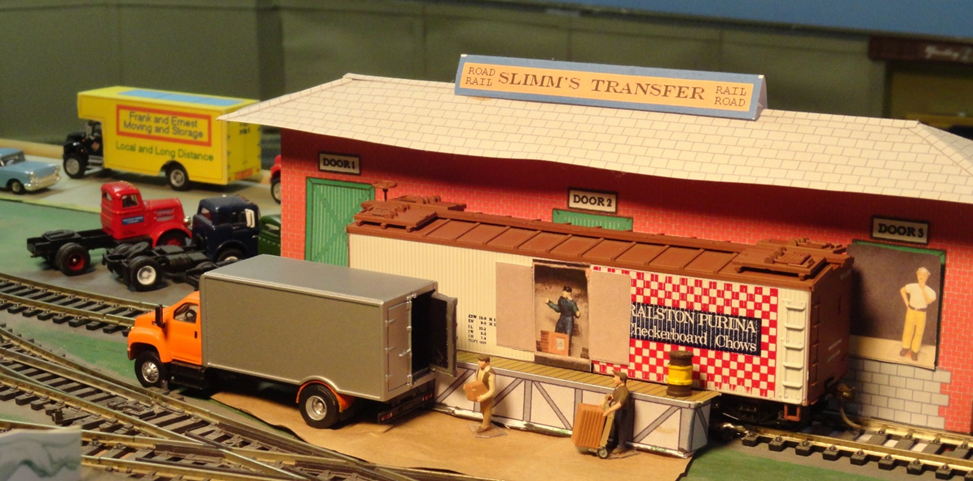
This car is by Train Miniatures at Slims Transfer in Hillton. The truck has a cut door glued open.
 Model Railroading on the Cheap
Leave a comment