A scrap iron drive reminds me of what was done at home on the farm during the Second World War. I recall grandpa donating an old horse drawn mowing machine to the effort. This was probably a couple-hundred pounds of cast iron. Things like this were done all across America in the early 1940s. The junk man came in his old truck seeking donations to the war effort. School kids saved chewing gum wrappers (tin foil), milk weed pods etc.; there was a paper drive also.
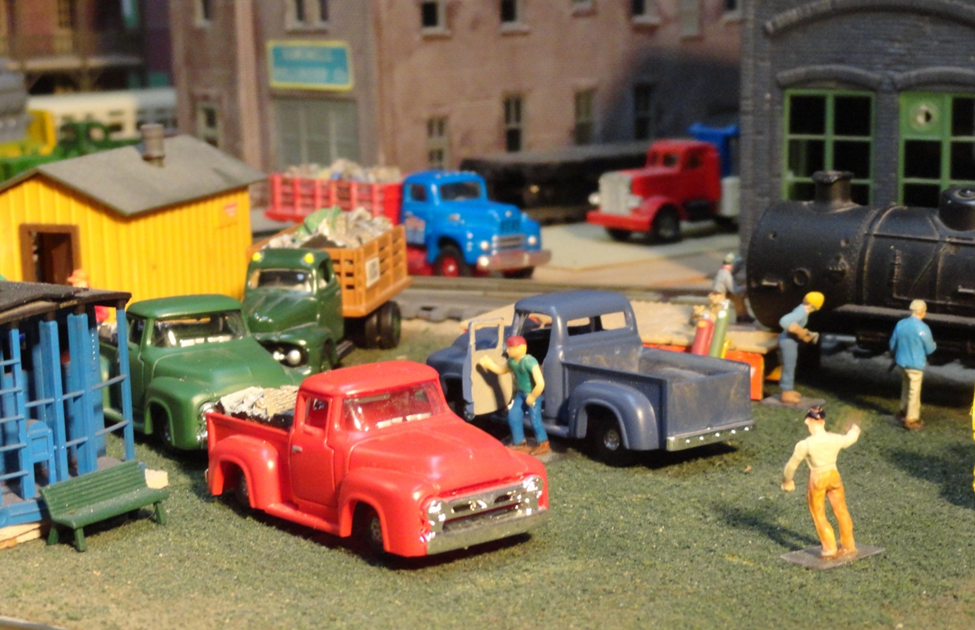
The caravan of trucks with the scrap drive has arrived at the Western Industrial Salvage Enterprise scrap yard. The blue pickup is already unloaded and is about to leave. An employee is directing the others to enter. In the back ground the torch men are cutting up an old steam engine boiler. Things seem a bit crowded if you ask me.
It is not necessary for all the scenes on the layout to deal with train movements. At a train flea market I bought a highly detailed cast resin gondola load of scrap, (or is it the ashes of a burn pile?) But it was too short for a gondola. It was pretty but I was not happy; later I cut it into smaller pieces to fit in highway trucks. I was able to get 4 truck-loads from one car load of hand painted cast resin scrap. This is shown on the next page. Scrap – even though rusted – should not be all the same color. Rust changes color with the weather, damp makes dark and dry makes lighter shades. Scrap can make for interesting open top loads for cars or trucks.
New Scrap Iron Drive
Here my 4 truckloads of scrap-iron are seen on Exchange Street in Hillton. In the foreground is my hollow home-made paper moving van cover “Frank and Ernest Moving and Storage” fitted on a conventional box truck. The Hillton Freight-Passenger Station is in background. The scrap iron drive looks like a parade of various trucks.

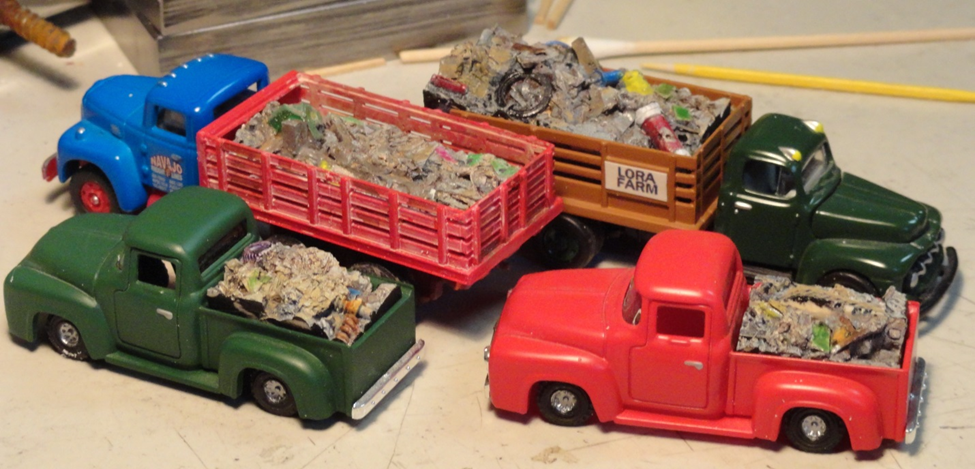
This is a good view of the loaded trucks with an overhead shot taken on the workbench. The blue International is by Classic Mini Metals after a bed swap, the green Ford stake body is Classic Metal Works and the pickup trucks are LifeLike plastic. Hard to believe that this all came from cutting up one cast resin load of molded scrap after brush painting with various believable colors. 4-2015.
Removable Scrap Load
I wanted a gondola load of scrap that was easily removable and would fit in several different gondola cars. That way I could return the car empty after its arrival at the scrap yard. I wanted to be able to pick the load off as one piece and store it out of sight till next time. 40 foot gondola suits my railroad better than 50 footers. I used a piece of cardboard from the back of a tablet cut to fit loosely in the bottom of the car. Upon that I glued several select items from my junk box that had been there for several years and that I would probably never use. I painted them with what I felt was believable shades of rust by mixing dabs of acrylic colors at the work bench. I tried to keep the colors light for use inside where the ambient light is less. While gluing them to the cardboard bottom with Walthers Goo I was careful to keep my load from bearing against the side of the car to be sure it would be easily removable.

To get my shades of rust I used acrylic paints and mixed dabs of white & brown with a trace of yellow or red on a disposable pallet at the work bench. This was just for a one-time job.
Viewing the other side of this load
Here is the same load now in a different car. It looks like it is most of the running gear of a poor running plastic locomotive. It is probably the bottom of the one under the scrapper’s torch seen in another view of our scrap operation. Even small layouts can have many different scenes for the camera.

The gondola car has had my corrugated side panels applied to an old plastic body gondola. I used Evergreen plastic siding material (no.4528) cut into strips as wide as between the posts, the edges chamfered with a file, cut to the length of the height of a side panel and glued with plastic cement. Then follow that with paint (black does not show details well) and your favorite decals.
Also seen is a couple scrapped ‘half’ boxcars which have been fitted with a wall and man door under the overhanging roof being used for tool sheds or storage barns. This is only visible from the other side of the boxcars. I made a couple of these from plastic boxcars with bad wheels and broken couplers. I gave a pair to a friend and kept this pair.
 Model Railroading on the Cheap
Leave a comment