Trains carrying over-sized loads were called “high and wide”. I think most model railroaders have a few interesting flat car loads; some even have a high and wide train or a hospital train carrying heavily damaged cars which have been in collision or something like a hopper car upside down on a flat car, or a bashed end box car. This subject is worthy of story and photos. In the train shown below the red Y&H caboose is a rider car for extra accommodations for the crew (inspectors) of this special train.

Most of my interesting loaded flat cars are self-contained. Real railroads disliked the High and Wide because it meant extra work and expense often with route restrictions, speed limits etc.

I found this airy curved arch bridge by Lionel (HO scale) at some train market. I liked the looks of it but was not able to put it on my layout without tearing up too much scenery work, and shortening it won’t work very well, so why not haul it to the site as a prefabricated bridge! (Not a very prototypical idea.) Here it is after I made some pivot supports on two flat cars with dummy couplers between them for tighter coupling. (less slack action) There are advertising placards there also.
These next two pics are to show both ends of this over length special handling shipment:

The P&LE drop end mill gondola car is by E&B Valley, the flat cars are old Mantua 40 footers with cast metal under-floors and plastic tops lettered for U S Navy.
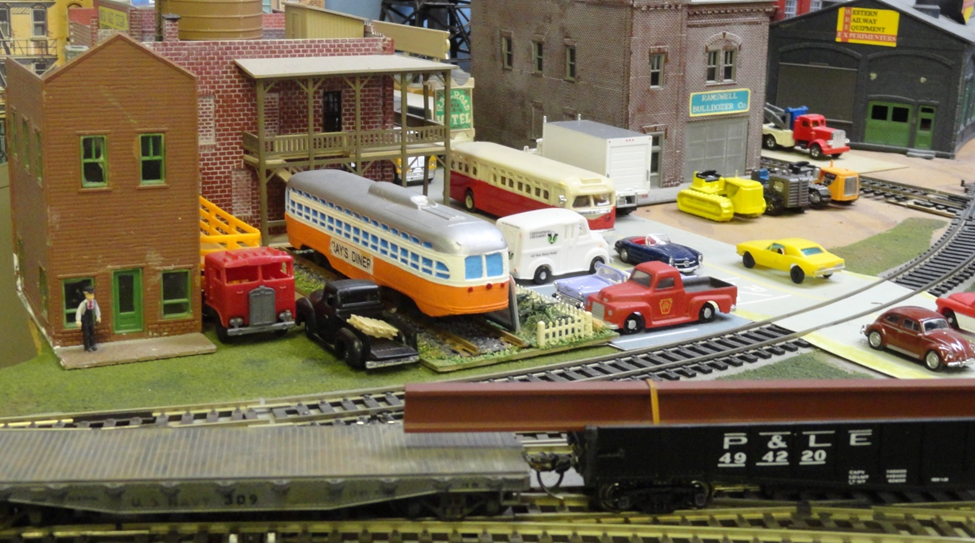
The load is neither high nor wide but long, it is an over length steel beam load carried on a drop end gondola with both ends folded down and dedicated flat cars to protect the ends. I recall seeing wood wedges driven into the coupler cut linkage to prevent uncoupling by accident. (Maybe at the hump yard?)
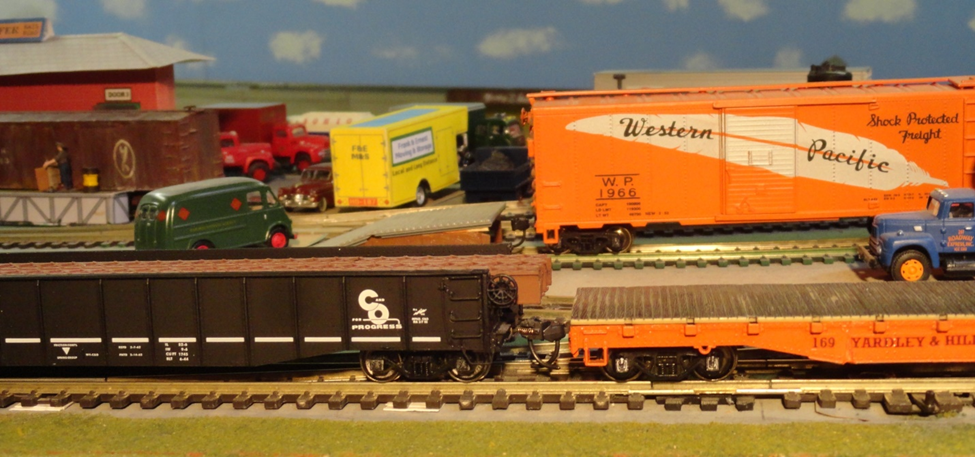
Here is a nice drop-end gondola with side mounted brake wheel (makes sense for a drop end car) and a load of steel roof trusses just a bit too long for inside. So the shipment requires a dedicated flat car. I agree with the railroads – operation with special handling trains like these is a burden!
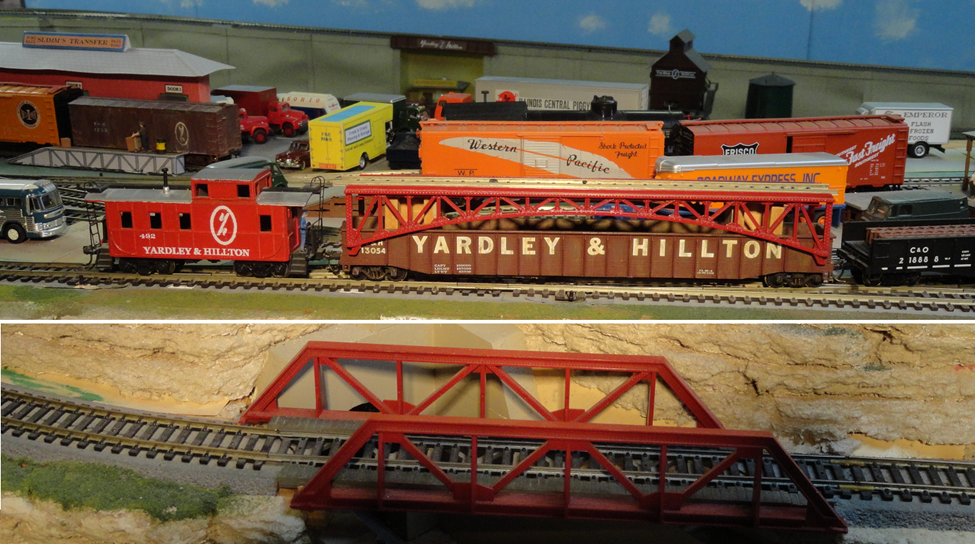
This picture (condensed from two) shows the cribbing under the pre-fab bridge load (complete with track) on my home made mill gondola (bashed from two) and the skewed truss bridge at Walbridge. Skewing was done where the bridge crosses the gap at an odd angle. (This one was done with just a few snips to the ends of the under-floor).
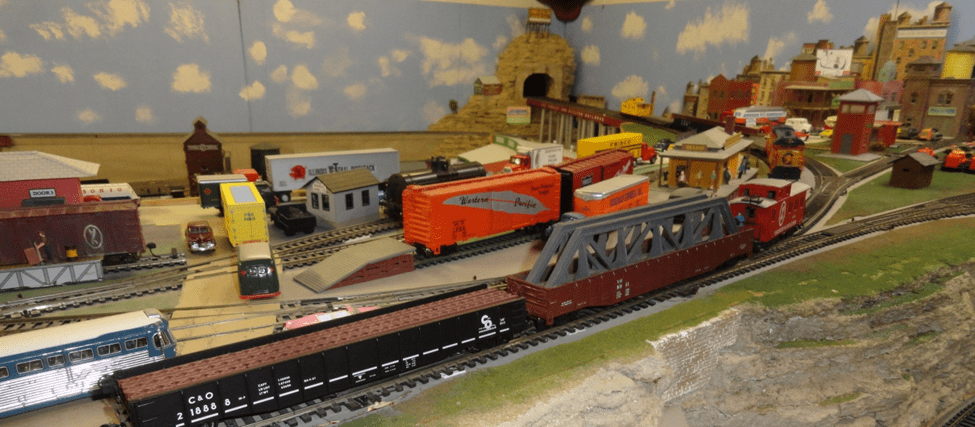
Here is another interesting load. Both sides of the popular gray truss bridge (by Tyco?) sit inside this 62 foot gondola, bashed in 1989. The load was made by joining the two bridge sides with a couple small pieces of plastic where the floor is supposed to fit. The floor is still in its package and can be split down the middle and widened to have extra flooring added for a double track (ballasted deck). I like the open top truss bridges for easier access when cleaning the track. While this load was contained within the car it would certainly qualify for slow speed restrictions.
The curved arch bridge carried on two flat cars is shown at Hillton. This view shows an alternate method for hauling long loads. Our new curved arch truss bridge is carried on a pair of dedicated flat cars at Hillton. As I continue to puzzle about how to show this curved chord truss bridge by Lionel on the layout, I will content myself by hauling it on a special handling train.

Bridges are a good place for a model railroader to show elaborate efforts. My elaboration came very late to this layout as I approach my eighth decade. July 2016
 Model Railroading on the Cheap
Leave a comment